
‘when they aren’t a sick laparotomy’
© GasGasGas – The FRCA Primary Anaesthetic Sciences Podcast 2025
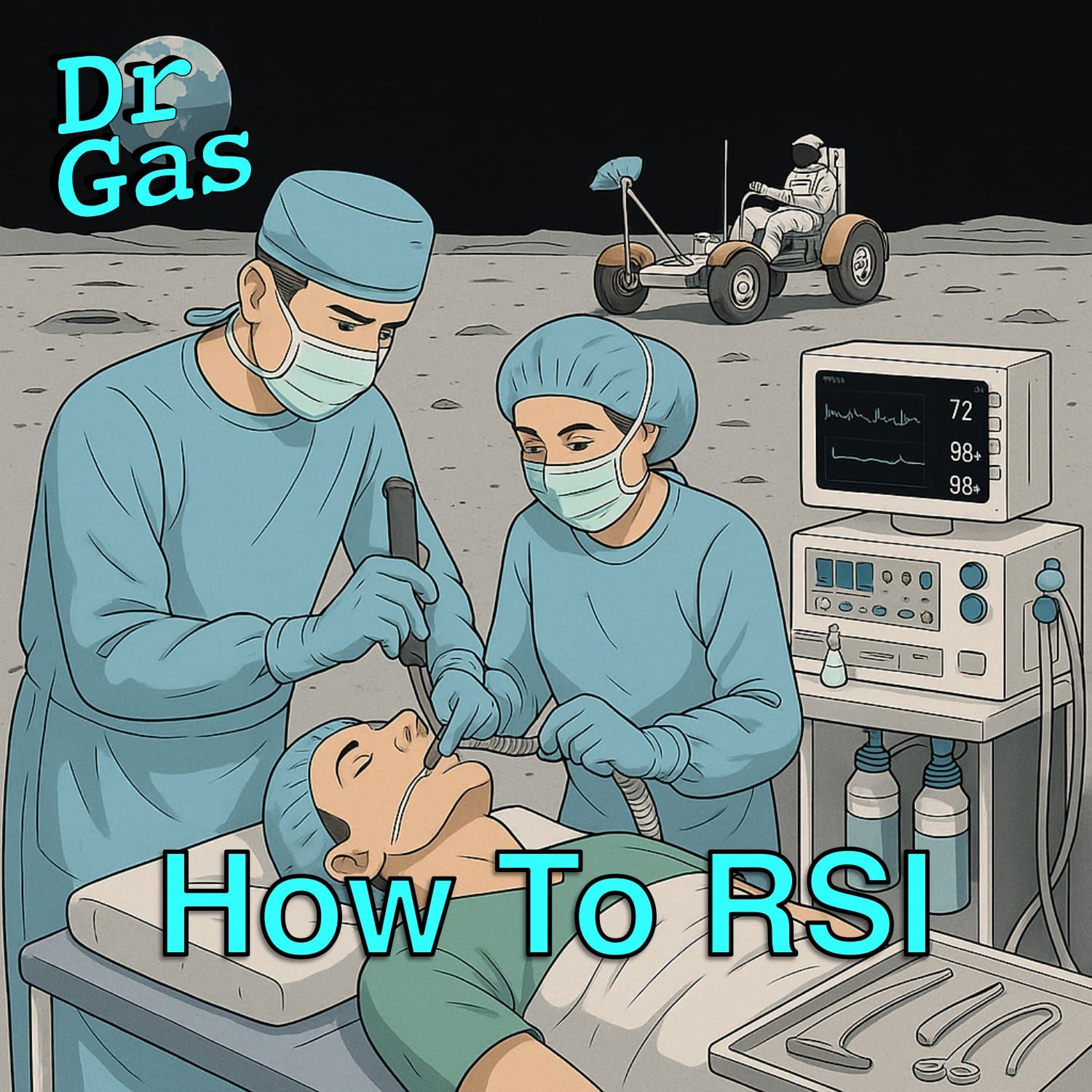
Wondering How to RSI? The daunting & perhaps mildly terror inducing world of undertaking your first RSI with the boss in the coffee room (or possibly at home) can be mitigated with proper and prior planning.
You might feel as if you’re the only person in the world, on the moon…. help so far away.. no one to hear your scream.
At the completion of IAC, it was one of the things that was a BIG worry in my mind. It probably feels like that for you right now.
There is more support and help than you realise, (ITU on call, Skilled ODPs, Obs anaesthetist on call) etc.
How you plan for this is quite individualistic and dependent on how you learn and manage yourself (figure this out if you haven’t already).
Dr Gas is on the ?neurotic end of the spectrum when it comes to such things. I learn by knowing more than enough theory so that when something doesn’t go to plan, i’ve at least read about the situation i’m in.. And this is where a ‘how will Dr Gas Conduct an RSI’ plan came to live in my notes on my phone.
It’s a tool to double check, that I’ve not missed anything, certainly useful at 2am when you need to be absolutely all over it. And with a pre-determined outlined plan – you can focus on the particulars to alter for the patient in front of you with greater ease.
I would recommend getting something like this on your phone, and modifying it to suit you! Naturally I have added more detail to flesh it out as a post!
Article Spring Board
History of RSI
Courtesy of this BJA article which you should definitely read in conjunction with this article!
I imagined the gist of it being – aspiration of stomach contents bad. Inducing anaesthesia takes a fair while with Ether etc, and patients were at risk of aspirating as they lost reflexes and took a protracted journey through the ‘wriggly’ plane of anaesthesia (between awake and deep anaesthesia.) That plane is far shorter given IV agents and the better volatiles of today.
Back in the Ether times the concept of endotracheal intubation was very sparsely applied, and most anaesthetics involved facemask holding for the case, this still continued for quite some time, as it ended up being COETT or Facemask + adjunct – as supra-glottic airway (SGA) devices like the iGel, LMA etc were yet to exist. (SGAs are kind of like facemasks for your vocal cords).
But as IV induction agents came on the scene an opportunity presented itself to try and reduce the potential for aspiration. in the 1950s quite a few deaths were attributed to regurgitation/aspiration/.
I like to think of RSI as taking a patient from being awake and defending their own airway to anaesthetised with a cuffed endotracheal tube defending their airway in the shortest practical time.
Large quantities of acid in your lungs is understandably bad news, causing acute bronchospasm and then a chemical pneumonitis causing inflammation and gas diffusion impairment.
Cricoid Pressure aka Sellick manoeuvre was described in 1961, although the evidence for its benefit is often called into question.
What is RSI in 2025?
RSI has journeyed from the:
- Classical Pre-O2 +Cricoid + Thio + Sux + Tube early days
- Modified with any drug, but give a good dose of relaxant so you can intubate promptly
- Progressing to Give drugs, don’t use cricoid, and maybe ventilate the patient too. Still with a high dose of relaxant, classically rocuronium.
Routinely doing the same rigid thing for every single patient probably fails to consider the situation you are in.
A patient with small bowel obstruction vomiting faecal matter probably needs something a bit more classical, with no accidental inflation of their distended faeces filled stomach for it to eject into the patients pharynx.
Whereas a patient who has sats of 88% on 100% fio2 will probably need some careful hand ventilation.
Cricoid pressure likely worsens your view on laryngoscopy, Video Laryngoscopy will counter this to some extent.
How to RSI ‘in theatre complex’
What is your anaesthetic plan – And discuss it with the Boss
Remember: Art/cvc/regional/neuraxial/post op PCA/post op I+V on ITU/Warming/ Blood products, available
- Ensure Team Brief has happened, and that if the patient is critically unwell ensure this is communicated (and boss is on the way)
- Check patient/surgery/Ventilator works [in AR and OR]/volatile in the tank/
- Check Anaes chart – did you assess? (if you didnt assess – advise run though the important things, and re-check airway)
- What’s your plan for Drugs – Induction Agent – Co-induction agent – Paralysis – Antibiotic – Analgesic/anti emetic plan
Induction drug doses you could consider:
- Propofol – 1 -2.5mg/kg up to 3mg per kg but in poorly folks obviously use less!
- Thiopentone – 2-7mg/kg draw up 500mg in 20mls of WATER for injection – 25mg/kg dose
- Ketamine 1-2 mg/kg
- Fentanyl 5-10 micrograms/kg to obtund reflexes completely (unusual outside of cardiac)
- Fentanyl 1-2mcg/Kg to co-induct
- Alfentanil 1-2mg of to co-induct
- Suxamethonium – 1-1.5mg/kg 45s / cessation of fasiculations (Don’t be cheap on the sux..I would err more to 1.5mg/kg..)
- Rocuronium – 1-1.2mg/kg in RSI 60s onset
- Could even pre-calculate your 16/mg/kg sugammadex dose in ampoules and have them out ‘please draw up and give each ampoule sequentially/quickly’
- Have Spare Propofol
- Know where the adrenaline 10ml syringes live – 1ml of this = 100 micrograms adrenaline
- Do you need dilute adrenaline for boluses ? (10mcg/ml) if you do, then this is a boss in the room job!
Plus metaraminol/epherdrine/glycopyrollate/Atropine available to you (drawn up if no pre-filed syringes, especially when you’re v.junior) I will generally always have metaraminol drawn up but remember this is you, in the AR/OR with less hands and you’ve less experience,
How to RSI: Do what is best for you right now.
Before induction
- Do you need the boss,
- where is the boss,
- are they happy with your anaesthetic plan
- You should be happy to RSI a otherwise fit appendicetomy case with distant aid (ITU SpR (if they’re anaesthetics trained), but not a laparotomy!
- Is an NG sited/Aspirated/ If they’ve SBO then this is quite critical
- Pre optimisation (overload, underload, vasodilation, electrolytes)
- if they’re poorly then volume is your likely your friend (and so is the consultant anaesthetist who should be in the room with you)
- As such It may be worth having a metaraminol infusion running and definitely working before induction, so that you can bolus and up titrate without waiting for it to get to the end of a cannula.
Planning with anaesthetic team
- Declare your airway plan before the patient arrives so that the team has a shared idea of the steps you may take
- (this helps you to make that step to bail out iGel if its already been explicitly discussed in the room)
- A Framework for this is the ABCD DASalgorithm
- Early ditching of cricoid pressure if poor view
- If FM vent difficulties despite Guedel + hypoxia then ditch cricoid > iGel…..
- Have a clear plan who the help is and where they are
- i.e. are you fast bleeping the Itu reg? is the boss in coffee room?
Kit:
- Suction readyincluding thin bore if they aspirate before you’ve intubated (try not to bag unless you have too, tracheal suction down the tube before spraying the contents further into their lungs)
- Face-mask that fits
- APL valve checked and set not fully closed@70cmh20
- Tubes varying sizes –
- If they have been smashed in the face with a sledgehammer – use an UNCUT tube
- Do you need an ITU tube with a supraglottic suction port on it?
- Laryngoscope (confirm works)
- Mc grath / other VL if challenges expected
- Boogie
- 8L+ of oxygen flow in circuit
- Tipping trolley if we’re being official (intubating a patient with SBO on a bed, whilst kind from a pain perspective might not end so well…)
Before you give Drugs ensure
- IV access with IVI running well
- I often feel for a temporal or radial (if im on the drug giving end) pulse, so I know it exists and thus if it ceases to exist something has changed.
- Monitoring inc ECG NIBP SPO2 – ETCO2 and ETO2 +/- BIS/nerve stimulator
- Positioning – Sniffing morning air +/- sat up,
- Did you Consider awake a-line – if you’re in unstable land, then your in consultant in the room land!
- Consider VL / bougie / stylet
- Cycle BP 2.5-5 mins
- 3-5 mins pre oxygenation or 6 VC breaths – tight fitted mask ET 02>0.8
You’ve started down the run way – you’ve hit the adequate 02/airspeed
- Confirm all in room are happy (yourself internally. and the ODP)
- Give The drugs
- (ODP will get automagically apply cricoid on as pt induced)
- Ensure Facemask seal maintained,
- Airway maintained in open position, ensure not over pressure,
- could bag gently depending on the case.
- Once induced some folks put volatile on, some turn it off and then tube, some leave it running
- there is increased risk of awareness with RSI,
- if you find yourself challenged and you’ve come out to FM ventilate it would be sensible to give a propofol bolus, 3-5mls will likely be sufficient to keep the fraction of agent in their CNS high (unless their BP is 4) that requires other steps…
Tube
- Extend neck (accounting for if the patient has RA/Trisonomy 21 or other reasons for cervical Subluxation risk)
- Open mouth with right hand
- Insert blade along right side of tongue
- possibly extend neck further with right hand
- The ODP does not have a third hand to open the side of the mouth for you until they have passed you the tube
- You may need to move the larynx into view, the ODP may be able to aid a little with shifting cricoid
- Progressive anatomical identification, let the odp know if it looks good/bad
- Into vallecula, and lift hyo-epiglottic ligament, exposing cords
- Tube into right side of mouth
If view is poor then ditch cricoid
Bougie tips,
- Dont under or over curve it
- Be gentle and don’t insert it excessively far
- If you rock over tracheal rings with it, that helps to confirm you’re in the right orifice
- You can use a bougie to lift the epiglottis up if you’ve a near G3 View.
- Be clear with your words when handing over the bougie to the ODP
How to RSI: ‘You have the bougie, I have the tube‘
Tube In
- SEVOFLURANE
- Check for Co2 and ease of ventilation / misting
- If no CO2 after a few hand ventilations then you’re:
- IN THE WRONG PLACE – Call for Help
- IN THE WRONG PLACE – Call for Help
- IN THE WRONG PLACE – Call for Help
- VERY RARELY the patient is in catastrophic bronchospasm because of suxamethonium. – Call for Help
- VERY RARELY the patient has anaphylaxis so severe there is scant cardiac output (the spo2 trace will have tailed to nothing and there will be other signs) – Call for Help
- VERY exceedingly, practically impossibly unlikely – the patient has arrested and you did not notice? – Call for Help
- Or you’re IN THE WRONG PLACE – Call for Help
- Make a decision to
- 1. Remove the tubeand FM ventilate
- 2. Re-assess on laryngoscopy and assess if the tube goes through cords (VL is better as ODP can agree/disagree) but it is on your shoulders.
- 3. If in doubt, take it out,
- Cricoid off please!
- Tie, but consider centering the tube in the mouth so that it doesn’t get fixed in the corner for days (on ITU) causing pressure injury.
- ?CVP line now
- ?OG/NG temp probe
- Antibiotics in
TRANSFER to theatre
- Ensure Observations are appropriate to transfer
- I may check to confirm temporal pulse again
- Flows off / volatile off
- Transfer patient into theatre
- Attach breathing circuit
- Standby off
- 4 litre flow o2
- Volatile on at appropriate %
- Appropriate settings for Ventilation
- Confirm CO2
- Check observations
Transfer on to table
- Monitoring working
- Alarms set – especially if its 2am!
- House keeping – Tube holder, Lines safe from patient
- Pressure areas, Eyes, Warmth – fluids and bair hugger
- Is your IV still dripping or is it now blocked
- Can you get at your three way tap with ease.
WHO CHECKs
DURING
- MAC + CO2ok?
- Anti emetics
- Morphine pre-emptively
- Flows down once at cruising altitude
- KTS think about toes and arm movement + laryngospasm
- Maintain paralysis as required with 10-20mg boluses rocuronium / atracurium
- Document: Ease of laryngoscopy and FM ventilation tube size/depth etc
RSI Checklist
It is worth also having an RSI checklist on your phone, for those ward intubations at 3am where all the kit is seemingly ready the patient needs help and you need to safely conduct an anaesthetic in a side room without an anaesthetic machine.
There are ICS Loccsips for this, and an abundance of check lists on the internet, and most of the time there will be a local one too.
Nothing will suit everyone, some folks want short and sweet, others want something that reminds them of the thing they always forget, you’re a doctor, and you should have a robust plan that keeps your patient and your team safe.
Patient
- Any previous intubations- Grade – Assess the patients airway
- Fasted?
- NG aspirated?
- Positioning of patient optimised
- IV access – with fluid running
- Monitoring – bp cycling
EQUIPMENT
- Suction
- Tilting trolley
- ETT + smaller sizes
- Cuff checked and ready
- Syringe on cuff or immediately available
- Tapes
- HME – T piece – Mask
- Bougie
- Laryngoscopes and blades
- Video laryngoscope
- Bail out air way kit – SGA etc
Drugs and team
- Emergency drugs – Metaraminol – Ephedrine – Glycopyrrolate – propofol – Suxamethonium – Atropine Emergent reversal at 16mg/kg suggamadex
- Brief team inc cricoid – plan for kit.
- Induction agents
It’s worth having a look at these other checklists for RSI – and maybe deciding on what your minimum standard is for doing this.
What’s coming soon?
How to look slick in front of the boss when its a sick laparotomy, which will be a bit like this, but less how to put a tube in and more, what the basics of sick patient laparotomy action is.
References
https://www.bjaed.org/article/S1743-1816(17)30565-6/fulltext
DAS Unexpected difficult intubation Guideline
“Thanks for listening guys… Every day you are getting better at this. Take it day by day, don’t overcook yourself, don’t freak out, and keep studying!”
Podcast Information
Listen to the Show On
Contact & Feedback
- Comments: Share your clinical experiences and ask questions!
- Corrections: Help us improve accuracy and clarity
- All of Toms’ Fan mail will get forwarded
- Email Us Here
Follow GasGasGas On
- FaceBook: Facebook – Gas Gas Gas
- BlueSky:Gas Gas Gas (@gasgasgaspodcast.bsky.social)
- InstaGram: GasGasGas
- X / Twitter: GasGasGasFRCA (@GasGasGasFRCA)
Leave a Reply