
Almost Everything You Need to Know About Opioids for the FRCA Primary Exam
4 August 2025
Contents
Complete GasGasGas Opioid Series
This series covers the (never, truly) complete opioid pharmacology curriculum for the FRCA Primary: receptor mechanisms, individual PK/PD profiles, neuraxial kinetics, and comparative clinical decision-making.
Your brain shall henceforth know…
Core Pharmacology: Understand how all opioids work through G-protein coupled receptors (μ, δ, κ, and NOP receptors), their intracellular mechanisms, and why these differences matter clinically (exam wise…).
Individual Drug Profiles: Complete pharmacokinetic and pharmacodynamic data for morphine, fentanyl, alfentanil, remifentanil, tramadol, methadone, oxycodone, and diamorphine.
Clinical Decision Making: Learn when to choose each opioid based on onset time, duration, context-sensitive half-time, and patient factors.
Neuraxial Applications: Be able to elaborate on the principles governing spinal and epidural opioid behaviour, from lipophilicity to rostral spread.
Advanced Concepts: Target-controlled infusion models, comparative pharmacology, and exam-style viva scenarios.
Episode Guide
Fentanyl show-note
>> Listen to the Fentanyl episode here
Probably better than morphine in almost every way but who can challenge the entrenchment of morphine in practice…
- 50-80x more potent than morphine
- Rapid onset (1-2 min) but short duration (20-30 min)
- High lipophilicity (600x morphine) drives rapid redistribution
- Perfect for co-induction and acute pain control
- Safer in renal failure, preferred (by me) for emergency transfers than alfentanil infusions
- Mu specific with perhaps fewer delta/kappa side effects
Morphine show-note
>> Listen to the Morphine Episode here
The reference opiate (for now?!) Forever…)
- Natural opiate alkaloid, everything else measured against it
- Slow onset (15-30 min) but long duration (3-4 hours)
- Active metabolites (M3G, M6G) accumulate in renal failure
- Excellent for neuraxial use due to low lipophilicity
- Historical context: from Sertürner’s 1803 discovery to modern applications
Alfentanilshow-note
>> Listen to the Alfentanil Episode Here
The rapid onset offset RSI friend
- Fastest onset of all opioids (<1 minute)
- pKa 6.5 means 89% unionized at physiological pH
- Short context-sensitive half-time ideal for ICU
- Perfect for RSI and obtunding laryngoscopy response
- Historical development from pethidine to modern synthetic derivatives
Remifentanil show-note
>> Listen to the Remifentanil Episode Here
The ultra-short acting Agent ‘ULTIVA’ TM
- Context-insensitive clearance (always ~9 minutes)
- Ester hydrolysis by plasma enzymes independent of organ function
- Minto TCI model for precise effect-site targeting
- Risk of opioid-induced hyperalgesia
- Perfect for TIVA and cases requiring rapid emergence
Tramadol show-note
>> Listen to the Tramadol Episode Here
The multimodal analgesic that seems to make folks go a bit weird
- Unique triple mechanism: μ-receptor + noradrenaline + serotonin
- Not fully reversible with naloxone
- CYP2D6 genetic polymorphisms affect efficacy
- Schedule 3 controlled drug with addiction potential
- Atypical side effects: mydriasis instead of miosis
Methadone show-note
>> Listen to the Methadone Episode Here
The complex multi-receptor agent
- Triple receptor activity: μ-opioid + NMDA antagonism + serotonin/noradrenaline reuptake inhibition
- Long half-life (15-55 hours) with tissue accumulation
- QT prolongation risk at higher doses
- Excellent for neuropathic pain and cancer management
- Growing role beyond addiction treatment
Oxycodone show-note
>> Listen to the Oxycodone Episode Here
The oral bioavailability champion, with concerns for moreishness and raging addiction
- Superior oral absorption (60-87%) vs morphine (30%)
- CYP2D6 creates potent active metabolite (oxymorphone)
- Historical context: 1916 German synthesis to modern opioid crisis
- 1.5-2x morphine potency with better side effect profile
- Modified-release no longer licensed for post-op pain (UK 2025)
Diamorphine show-note
>> Listen to the Diamorphine Episode Here
The neuraxial favorite
- Pro-drug rapidly converted to 6-O-acetylmorphine then morphine
- Moderate lipophilicity perfect for neuraxial use
- Balanced onset (10-20 min) and duration (8-12 hours)
- Ideal for caesarean sections and obstetric anesthesia
Neuraxial Opiate Kinetics show-note
>> Listen to the Neuraxial Opiate Kinetics Episode Here
The spinal journey explained
- Anatomical barriers: epidural fat to substantia gelatinosa
- Physicochemical factors: lipophilicity, molecular weight, pKa
- Octanol-water buffer coefficients and clinical implications
- Rostral spread and delayed respiratory depression
- Drug selection based on desired onset, duration, and spread
Comparing Opioids show-note
>> Listen to the Comparing Opioids Episode Here
Clinical decision-making and chatting opiates in that exam
- RSI drug selection: onset vs duration considerations
- Context-sensitive half-time implications for infusions
- Renal impairment: which opioids to avoid and alternatives
- Neuraxial selection based on lipophilicity
- Exam-style viva scenarios with model answers
Start with any episode, and if you have forgotten what PKA is, there is an episode for that!
Key Pharmacological Concepts
All clinically used opioids share a common mechanism: agonism at Gi-protein coupled receptors (μ, δ, κ, NOP) causing cellular hyperpolarisation, reduced Ca²⁺ influx, adenylyl cyclase inhibition, and increased K⁺ conductance.
Structure-Activity Relationships: From morphine’s natural structure to synthetic modifications creating fentanyl, alfentanil, and remifentanil - understand how chemical changes affect clinical properties.
Pharmacokinetic Principles:
- pKa determines onset speed (alfentanil 6.5 vs fentanyl 8.4)
- Lipophilicity affects redistribution, onset and duration
- Protein binding creates reservoirs affecting kinetics
- Context-sensitive half-time crucial for infusion decisions.
Clinical Applications
Rapid Sequence Induction: Choose alfentanil for speed
Neuraxial Anaesthesia: Morphine for duration, fentanyl for speed of on/off and diamorphine for balance. (morphine does climb the CSF ladder to the Resp centre and PAG…)
ICU Sedation: Alfentanil wins over fentanyl due to context-sensitive half-time.
Special Populations: Renal failure considerations, elderly dosing, genetic polymorphisms.
Emergency Medicine: Transfer protocols, acute pain management, cardiovascular stability.
References
McDonald J, Lambert DG. Opioid receptors. BJA Education 2015;15(4):219–224. https://www.bjaed.org/article/S2058-5349(17)30129-4/fulltext
Velayudhan A et al. Opioid-induced hyperalgesia. BJA Education 2014;14(3):125–129. https://academic.oup.com/bjaed/article-abstract/14/3/125/341104?redirectedFrom=PDF
Episodes in this chapter
Ep 3 – Fentanyl For The FRCA Primary
Fentanyl pharmacology for FRCA Primary: mu-opioid receptor mechanism, pharmacokinetics, opioid receptor subtypes (MOP/DOP/KOP/NOP), and clinical dosing.
8 Nov 2024
Ep 15 – Morphine for the FRCA Primary Exam
Morphine for the FRCA Primary: mu-opioid receptor mechanism, pharmacokinetics, M3G/M6G metabolites, and intrathecal delayed respiratory depression.
22 Nov 2024

Ep.22 – Alfentanil for the FRCA Primary
Alfentanil is a short-acting μ-opioid receptor agonist used in RSI, ICU sedation, and acute analgesia — FRCA Primary pharmacology examined in full.
28 Apr 2025

Ep.28 – Remifentanil and the Minto Model
Remifentanil pharmacology for the FRCA: ester hydrolysis, context-sensitive half-time, opioid-induced hyperalgesia, and the Minto TCI model effect-site targets.
9 Jun 2025
Ep 23 – Tramadol for the FRCA Primary Exam
Tramadol pharmacology for the FRCA Primary: multimodal mechanism (mu-opioid, noradrenaline, serotonin), CYP2D6 metabolism, active metabolite, serotonin syndrome.
7 May 2025
Ep 24 – Methadone for the FRCA Primary
Methadone pharmacology for FRCA Primary: µ-opioid agonist, NMDA antagonist, CYP3A4/2D6 metabolism, QT prolongation, and opioid substitution therapy.
10 May 2025
Ep 25 – Oxycodone for the FRCA Primary
Oxycodone: semi-synthetic opioid, 60–87 % oral bioavailability, CYP3A4/2D6 metabolism, and equipotency conversions for FRCA Primary pharmacology.
22 May 2025
Ep 25 – Diamorphine
Diamorphine pharmacology for the FRCA Primary: mechanism of action at mu opioid receptors, pro-drug metabolism to 6-O-acetylmorphine, neuraxial use, and M6G accumulation in renal failure.
29 May 2025
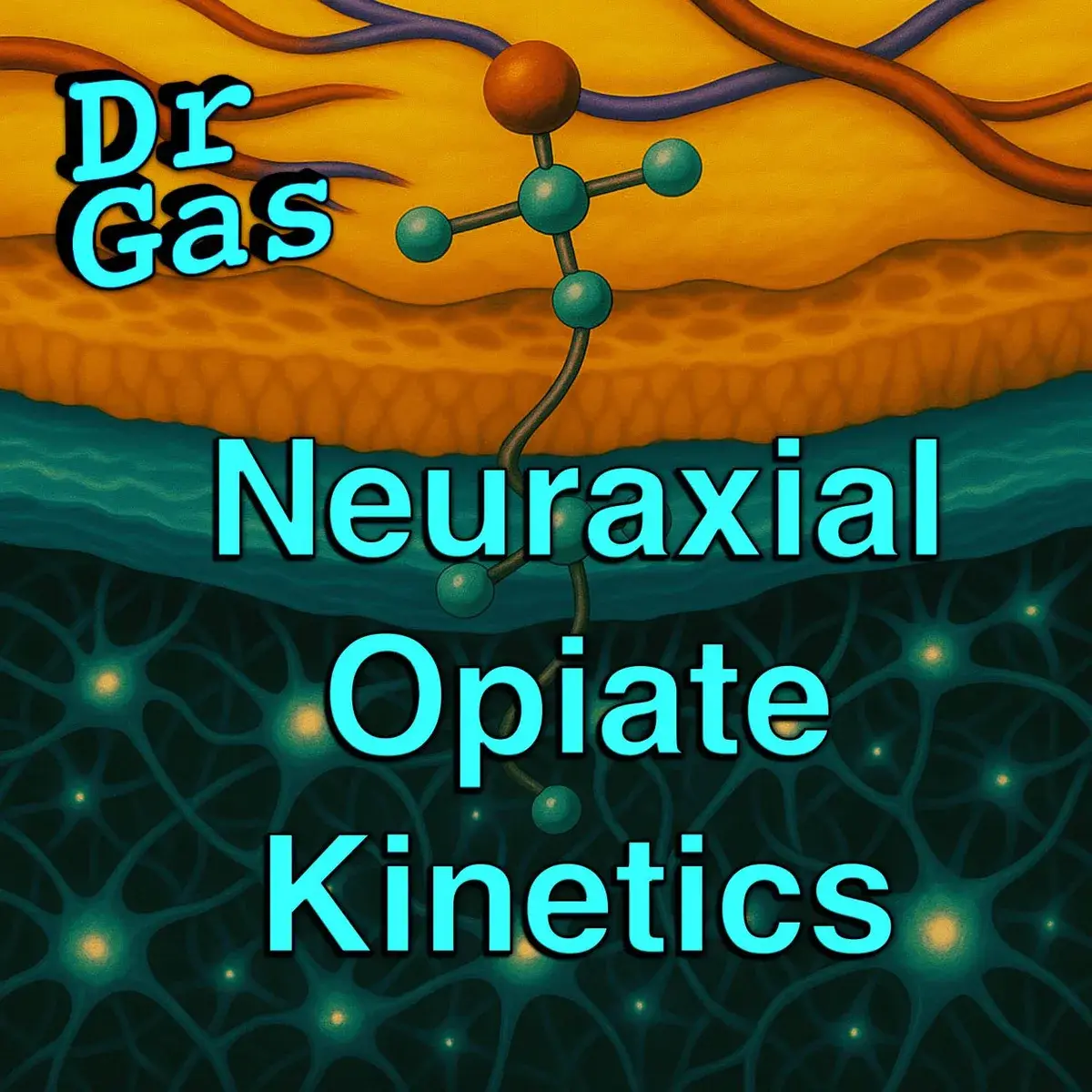
Ep.26 – Neuraxial Opiate Kinetics
Neuraxial opioid pharmacology for FRCA: lipid solubility, pKa, and molecular weight govern epidural and intrathecal behaviour of morphine, fentanyl, and diamorphine.
1 Jun 2025
Ep.29 – Comparing Opioids For the FRCA Primary
Comparing opioids for the FRCA Primary: pharmacokinetics, context-sensitive half-time, neuraxial selection, renal failure prescribing, and receptor pharmacology.
17 Jun 2025
Common questions
What are the key differences between opioids for rapid sequence induction?
Alfentanil has the fastest onset (<1 minute) due to pKa 6.5 making 89% unionized at physiological pH, ideal for obtunding laryngoscopy response. Fentanyl has rapid onset (1-2 minutes) but higher lipophilicity (600x morphine) causing rapid redistribution. Remifentanil provides context-insensitive clearance (~9 minutes) but requires careful transition planning due to ultra-short duration.
How do lipophilicity differences affect neuraxial opioid selection?
Low lipophilicity opioids (morphine) remain in CSF longer, providing prolonged analgesia (8-24 hours) but risk rostral spread and delayed respiratory depression. High lipophilicity agents (fentanyl) rapidly penetrate spinal cord for fast onset (5-10 minutes) but shorter duration (2-4 hours) with minimal rostral spread. Diamorphine offers moderate lipophilicity providing balanced onset (10-20 minutes) and duration (8-12 hours).
What makes tramadol unique among opioids?
Tramadol is unique among opioids in having activity at the mu-opioid receptor and also inhibiting noradrenaline and serotonin reuptake. CYP2D6 metabolism produces the more potent O-desmethyltramadol metabolite, so analgesic response varies with metaboliser status.
What are the key receptor mechanisms for opioid action?
All opioids work through Gi-protein coupled receptors (μ, δ, κ, and NOP) causing cellular hyperpolarization via three mechanisms: increased potassium conductance (making cells more negative), decreased calcium influx (reducing neurotransmitter release), and adenylyl cyclase inhibition (reducing cAMP). This results in reduced pain transmission at spinal and supraspinal levels, with μ-receptors being the primary target for analgesic effects.
Thanks for listening. Take it day by day, don't overcook yourself — keep studying.
Enjoyed this? Review on Apple Podcasts Rate on Spotify
Support the show SBA question bank @ Teach Me Anaesthetics