
© GasGasGas – The FRCA Primary Anaesthetic Sciences Podcast 2025
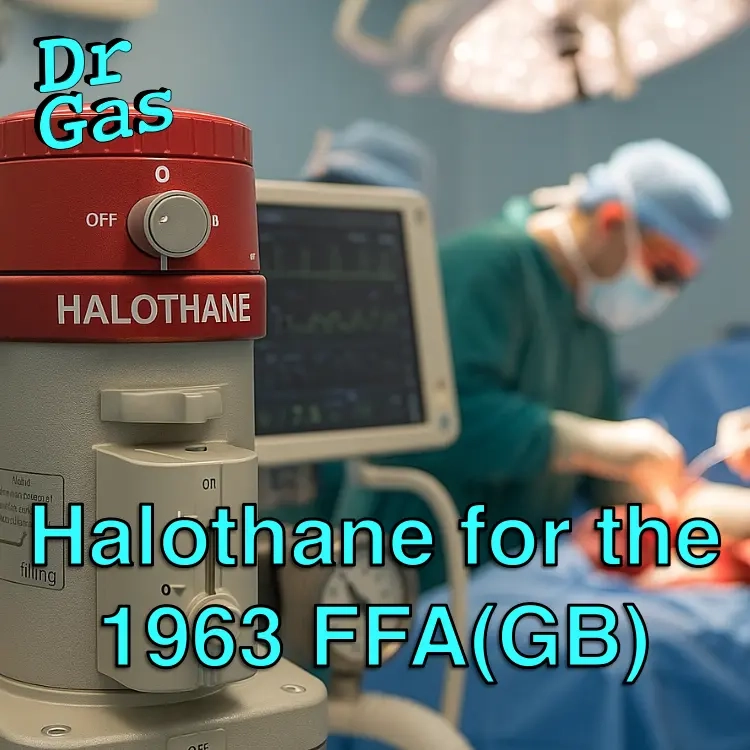
With the advent of halothane, smoking, static and other sizzling was back in style! Gone were the explosive diethyl ether, acetylene, trichloroethylene and cyclopropane anaesthetics of the 1950’s and with it a new era of fewer explosions, and possibly a greater prevalence of post operative liver distress.
The evolution of anaesthesia started from early human kind, the Africa rift valley system being well known for its research output and citation rate. Beginning with, and progressing onwards from Australopithicus > Homo.Sapiens > Homo.Halothanus > Homo.Propofolopithicus > Homo.magneto-obliterans?
This episode is part of the volatile anaesthetic agents series that kicked off with ‘an introduction to volatiles‘, Sevoflurane also an episode on isoflurane for the FRCA.
Article Spring Board
Halothane Physico-Chemical properties
| Name | Halothane – Brand Name Fluothane |
| Class | Halogenated hydrocarbon (containing bromine, chlorine and flourine) (the halogenation makes it stop bursting into flames) |
| Chemical Make Up | [math]C_{2}HBrClF_{3} [/math] 2-bromo-2-chloro-1,1,1-trifluoroethane |
| History | First synthesised in 1951 by Dr Suckling at ICI (Imperial Chemical Industries), clinical use from 1956 with the first research into its use coming from Manchester Royal Infirmary |
| Isomer Status | It is an Enantiomer – (R)-halothane and (S)-halothane, |
| Colour/Appearance | Clear Colourless liquid – Non-flammable with a sweet smell Commercial prep contains 0.001% thymol stopping bromine liberation |
| Stability | Is decomposed by UV light! (into phosgene, free chlorine and other things that are very bad for you!) (hence amber bottles, + thymol Phosgene is : colourless, non-flammable, and whilst a component in industrial chemistry applications, it also saw use as a chemical weapon in WW1 – in high concentrations its very irritant to airways and causes pulmonary oedema. Free Chlorine: Again saw use as a WW1 Chemical weapon, triggering pulmonary oedema, there have been accidental exposures when mixing of cleaning agents liberates chlorine (BBC News Article) Halothane is readily soluble in rubber, in presence of water vapour will attack brass, aluminium and lead. Was also bad for the Ozone Layer, chiefly the chlorine and bromine that gets liberated |
| Molecular weight | 197.4g/mol |

Physico-Chemical Properties
| Halothane Boiling Point | 50.2 °C |
| Halothane Saturated Vapour Pressure (@20°C) | 32 KPa |
| MAC of Halothane | 0.75% |
| Blood:Gas Solubility Coefficient Halothane | 2.5 |
| Oil:Gas Solubility Coefficient Halothane | 220 |
| ‘Safe’ pollution level | 10ppm |
Halothane Pharmacodynamics & Side Effects
| Mechanism of Action | Volatiles seem to disrupt synaptic transmission – especially ventrobasal thalamus ‘Meyer-Overton’ – expansion of hydrophobic regions in the neuronal membrane either within the lipid phase or within the hydrophobic sites of cell membrane proteins ‘Gets around the CNS and causes mischief that renders people hypnotised, amnesic and generally less mobile’ |
| Chief Effect / Actions | Hypnotic |
| Dose | See End Tidal Mac for Dosing |
| Cardio-Vascular Side Effects | Headline: Ventricular and Brady-Arrythmias – exacerbated By hypoxia, hypercapnia, SNS excited state, adrenaline administration. Cardiac sensitivity to catecholamines is ++ increased (use <100mcg/kg/10mins of adrenline in LA) Chronotropy : -ve chronotrope due to the PSNS/Vagal stimulation of Halothane Slowing SAN Inotropy : Direct Myocardial Depressant effect Possibly due to Ca2+ influx inhibition Dromotropy : AVN depressed Lussitropy : Coronaries: Minimal effect to Coronary blood flow Systemic Vascular Resistance:Drops by ~15% Cardiac Output: Dose dependent drop in CO |
| Respiratory Side Effects | Rate – Increased Depth – Decreased Parenchymal effects: > Hypoxic pulmonary vasoconstriction inhibited > Bronchodilating > NON-Irritant > Histamine Release Inhibition |
| Central Nervous System Side Effects | ICP : Raised Cerebral Vasculature: Dilated CMRO2: depressed Seizure Threshold : n/a Nausea and vomiting: as with all volatiles |
| Gastro-Intestinal Side Effects | Reduced Salivation Slowed GI motility Reduced Splanchnic blood flow |
| Renal Side Effects | Renal Blood Flow: Reduced ~40% GFR: reduced ~50% |
| Metabolic/MSK: Side Effects | Reduced plasma NorAdrenaline concentraiton Increased Thyroxine levels Increased Growth Hormone levels Inhibits NO synthase (this will inhibit vascular dilation due to nitric oxide) Inhibits Leucocyte phagocytosis |
| Obstetric | Uterine hypotonic |
| General Acute Toxicity Signs | Malignant Hyperthermia Trigger End point of volatile toxicity: CVS collapse, but also in this case VF/VT etc. |
Halothane Pharmacokinetics
| Absorption | |
| Distribution | Extensively, prioritising high cardiac output areas first |
| Metabolism | Phase I : [oxidation, reduction, hydrolysis] (more cytochrome action here) Phase II: [conjugation, glucoronidation, acetylation, sulphylation] 20-25% (perhaps up to 50%!) of Halothane is metabolised by the liver In normal circumstances metabolism via the oxidative pathway p450 2EI. > oxidation and subsequent dehalogenation leading to trifluoracetic acid and tri-flouro-acetyl ethanolamide, chloro-bromo-di-flouroethylene and chloride and bromide radicals <1% is reduced by CYP2A6 and 3A4 – liberating -ve fluorine and di flouro/tri flourethanes these molecules can undergo lipid peroxidation and can end up being toxic. Hypoxic liver does more reduction and increases hepatic upset. Some literature blames this reductive pathways metabolites for the Type Two Hepatitis. But the antigens that form in a fulminating hepatitis are Vs Tri-Flouro-Acetic Acid (Science is not 100% clear on the cause.) |
Active Metabolites: Other Routes: | |
| Elimination | 60-80% exhaled unchanged – 3 weeks for all the metabolites to get fully cleared out |
Two Types of Halothane Hepatotoxicity
This reaction was first noted in patients who had Chloroform anaesthesia….(but not Ether!)
Type One – Halothane Hepatitis
A reversible, transient transaminitis that is often sub clinical 1:20- 1:3 people would develop this
The rise occurs 1-2 weeks post exposure – covalent bonding of metabolites to cellular components – more likely in hypoxic conditions – this is self limiting.
Type Two – Fulminant Halothane hepatitis/necrosis 50-75% morte
The first sign of developing fulminant liver injury being pyrexia, rash, joint pain, preceding a jaundice presentation by up to a month, leading to a fulminant hepatitis which has high mortality without liver transplant
- 1 in 80-200k Kiddies
- 1 in 2500-35000 adults
- Usually pre-exposed to Halothane, more exposures, more risk
- May have had a history of delayed onset fever and jaundice
- Genetic element may be present, as family hx of halothane hepatitis increases your risk.
n.b.The exact mechanism is not entirely clear.
Pathophysiology of Fulminant Hepatitis
- Immune mediated vs hepatocytes
- A metabolite covalently bonds to liver proteins, producing the so called Hapten
- The offending molecule is a CYP2E1 mediated metabolite called Tri-Flouro-Acetyl Chloride.
- This binds to hepatic proteins forming a molecule that is considered an antigen in the eyes of your immune system.
- Immune system produces Anti TFA – (tri-flouro-acetyl) antibodies, which are blamed for the wreckage!
You do produce Tri-Flouro-Acetyl Chloride, when metabolising other volatile anaesthetic agents (enflurane, isoflurane but to a much lesser extent), but it is produced in very high quantities during halothane anaesthesia due to its high fraction that is cleared metabolically.
It is recommended that there is a 6 month gap between each halothane anaesthetic to reduce the risk of this lethal process or to chuck it out and get something else in your department.
References
- Halothane hepatitis type 1 and type 2 – Handbook of experimental pharmacology, pg 130
- Beyond ether and chloroform – A major breakthrough with halothane, Journal of Anesthesia History (2017), doi: 10.1016/j.janh.2017.05.003
- What is Phosgene
- Why is Free Chlorine Gas bad?
- GERALD W. BLACK, A REVIEW OF THE PHARMACOLOGY OF HALOTHANE, British Journal of Anaesthesia, Volume 37, Issue 9, 1965, Pages 688-705,
- Ray, David & Drummond, Gordon. (1991). Halothane hepatitis. British journal of anaesthesia. 67. 84-99. 10.1093/bja/67.1.84.
- Habibollahi P, Mahboobi N, Esmaeili S, Safari S, Dabbagh A, Alavian SM. Halothane-induced hepatitis: A forgotten issue in developing countries: Halothane-induced hepatitis. Hepat Mon. 2011 Jan;11(1):3-6. PMID: 22087107; PMCID: PMC3206652.
- s
- Vickers MD. Fire and explosion hazards in operating theatres. Br J Anaesth. 1978 Jul;50(7):659-64. doi: 10.1093/bja/50.7.659. PMID: 150280.
- ATOTW Airway Fires – https://resources.wfsahq.org/wp-content/uploads/353_english.pdf
- Environmental emergencies in theatre and critical care areas: power failure, fire, and explosion https://www.bjaed.org/action/showPdf?pii=S1743-1816%2817%2930006-9
“Thanks for listening guys… Every day you are getting better at this. Take it day by day, don’t overcook yourself, don’t freak out, and keep studying!”
Podcast Information
Listen to the Show On
Contact & Feedback
- Comments: Share your clinical experiences and ask questions!
- Corrections: Help us improve accuracy and clarity
- All of Toms’ Fan mail will get forwarded
- Email Us Here
Follow GasGasGas On
- FaceBook: Facebook – Gas Gas Gas
- BlueSky:Gas Gas Gas (@gasgasgaspodcast.bsky.social)
- InstaGram: GasGasGas
- X / Twitter: GasGasGasFRCA (@GasGasGasFRCA)
Transcript HALOTHANE
===============================================================================
INTRODUCTION AND WELCOME
[00:00-00:47]
Hello, Team Anaesthesia. Welcome to Gas Gas Gas. This is the best anaesthetic science podcast for the FRCA primary exam. Our goal is to fill your brain with all this highly useful information. Now you might be in the gym right now, commuting, or ironing your scrubs, and there’s no judgement here. Gas Gas Gas will prime your brain for the monsoon of knowledge you need to imbibe. But regardless, the revision is eventually going to end. But for now, expect facts, concepts, model answers, and the odd tangent.
Now remember to check out the website, that’s gasgasgas.uk. There are show notes there with all the detail plus links to foundational reference papers and anything else useful I find for you guys. Anyway, buckle up. Get ready for your mind to be bent into a new shape and let’s get on with the show.
===============================================================================
EPISODE OVERVIEW: WHY STUDY HALOTHANE?
[00:47-02:35]
SUMMARY:
- Halothane marked a pivotal shift from explosive to non-flammable anaesthetics
- Understanding its history provides context for modern anaesthetic practice
- Despite being largely obsolete, it remains important for FRCA examinations
- Introduced non-explosive anaesthesia, eliminating the need for anti-static precautions
FULL TRANSCRIPT:
Hello everyone, this episode is going to explore halothane. This is an important anaesthetic gas to understand when you’re studying for the diploma in anaesthesia or in fact the fellowship of the faculty of anaesthetists, the FFA exam in Great Britain. Admittedly, you might be sitting this if we’re in 1960. But nevertheless, halothane kind of marks a big shift in anaesthetic agents from those that had a proclivity for exploding and those which are less inclined.
Which is a big pivot in safety, and the reason why we have anti-static shoes still, amongst other reasons, I’m sure. With the advent of halothane, smoking was back in fashion, static was fine, and sizzling tissues whilst wafting halothane around the place in a liberal manner, was all the rage. Gone were the explosive diethyl ethers, the acetylenes, the trichloroethylenes, and the cyclopropane anaesthetics of the 1950s. And a world of fewer explosions, but perhaps possibly maybe a greater prevalence of post-operative liver distress.
I think it’s always worth understanding where we’ve come from to have a better appreciation of where we are today. With the evolution of anaesthesia beginning from early humankind in the African Rift Valley system, which was well known for its research output and citation rates. It all began with hominids such as Australopithecus roaming the savannas of this Rift Valley system clonking each other on the head, to Homo sapiens with their ether, to Homo Halothanus. And nowadays to Homo propofolopithecus, which we are all fortunately members of. I’m just imagining the evolutionary progression of anaesthetists. Will it be Homo magneto obliterans next? I don’t know. Anyway. Let’s get on with it.
===============================================================================
PHYSICOCHEMICAL PROPERTIES OF HALOTHANE
[02:35-06:38]
SUMMARY:
- Name: Halothane (brand name: Fluothane)
- Class: Halogenated hydrocarbon containing 3 fluorines, 1 bromine, 1 chlorine
- First synthesised 1951 by Dr Suckling at Imperial Chemical Industries (ICI)
- First clinical use: 1956 at Manchester Royal Infirmary
- Enantiomer with R and S forms
- Presentation: Clear, colourless, non-flammable liquid with sweet smell
- Contains 0.001% thymol to prevent bromine liberation
- Molecular weight: 197.4 g/mol
- Boiling point: 50.2°C
- Saturated vapour pressure: 32 kPa at 20°C (cf. sevoflurane 22.7 kPa)
- MAC: 0.75% (very potent compared to desflurane 6.6%, sevoflurane 2.0-1.8%, isoflurane 1.2%)
- Oil:gas partition coefficient: 220 (very high; cf. sevoflurane 47)
- Blood:gas partition coefficient: 2.5 (quite soluble; cf. sevoflurane 0.69)
STABILITY CONCERNS:
- UV light decomposes halothane → free chlorine + phosgene (both toxic, WWI chemical weapons)
- Phosgene causes pulmonary oedema
- Soluble in rubber (soaks into old black rubber circuits)
- Attacks brass, aluminium, and lead in presence of water vapour
- Damages ozone layer (chlorine and bromine liberation)
FULL TRANSCRIPT:
Halothane. What are the physicochemical properties of halothane? Well, it’s called halothane for a start. Its brand name once upon a time was Fluothane. That’s because of the fluorine. And its class is a halogenated hydrocarbon. The halogenation aspect of it is really the shift that made this thing stop exploding from its non-halogenated hydrocarbon volatile pals.
It contains three fluorines, one bromine, and one chlorine. It was first synthesised in 1951 by someone called Dr Suckling at ICI, that’s Imperial Chemical Industries. Now Imperial Chemical Industries was owned by a British lord that was involved in making lots of explosives and other useful or non-useful things in several of the wars, but it pivoted to making other chemicals, and halothane saw its first clinical use really from 1956, with research coming out of Manchester Royal Infirmary. So go UK inventing and bringing to market yet another thing once upon a time. Now we don’t.
Halothane is an enantiomer. So there’s an R and an S halothane. It is presented as a clear, colourless, non-flammable liquid with a sweet smell. Its commercial preparation contains 0.001% thymol. This stops liberation of bromine. Thymol is derived from thyme. That delightful herb.
What about the stability of halothane? So ultraviolet light and halothane do not mix. It is decomposed into free chlorine and phosgene. Now you might have heard of phosgene. Doesn’t sound good for you, does it? Phosgene is a colourless non-flammable gas. And whilst it is useful from an industrial chemical application perspective, was also a chemical weapon in World War One, in high concentrations. It’s very irritant to the airways and causes pulmonary oedema, so you wouldn’t want to spill halothane on the floor and not bother cleaning it up again.
It also liberates free chlorine. If you can think free chlorine, that’s probably not good for you. And you’re right. Again, free chlorine gas was used as a chemical weapon. It again triggers pulmonary oedema, but there have also been accidental chemical gas exposure events when people have been mixing cleaning agents which inadvertently liberate chlorine. There’s a BBC News article in the show notes that describes someone trying to alter the chemical additives in a hotel pool and then made a lot of people very sick.
Halothane is also readily soluble in rubber. So it was often found to soak into those old-fashioned black rubber mask anaesthetic circuits. And in the presence of water vapour, it gets about attacking brass and aluminium and lead. Also, halothane is bad for the ozone layer because of the chlorine and bromine that gets liberated up there. Doesn’t sound like I’m selling it to you right now, does it?
Its molecular weight is 197.4 grams per mole, which is somewhat similar to most of the volatile anaesthetics. Halothane boils at 50.2 degrees, this is a bit less than sevoflurane, but has a higher saturated vapour pressure. Halothane’s saturated vapour pressure is 32 kilopascals at 20 degrees C, whereas sevoflurane is at 22.7.
So in and of itself, halothane is really quite potent. Okay, so to achieve one MAC of halothane, your end-tidal halothane concentration needs to be 0.75%, which is really low. Remembering desflurane is 6.6, sevoflurane hovering around the 2.2 to 1.8, and isoflurane 1.2. So you can therefore infer that halothane is really quite potent.
And it has an oil:gas solubility coefficient of 220, which is proper high. Remember the oil:gas solubility partition coefficient of sevoflurane is 47. However, halothane’s blood:gas solubility coefficient is 2.5. Pair that to the 0.69 of sevoflurane. So it is really quite soluble in the blood.
===============================================================================
PHARMACODYNAMICS: RESPIRATORY SYSTEM
[06:38-07:30]
SUMMARY:
- Respiratory depressant with dose-dependent effects
- Decreases tidal volume and increases respiratory rate
- Reduces minute ventilation overall
- Bronchodilator properties
- Abolishes hypoxic vasoconstriction, leading to V/Q mismatch
- Increases dead space
- Shifts CO₂ response curve down and to the right
FULL TRANSCRIPT:
Pharmacodynamics. Let’s talk respiratory system. It is a respiratory depressant. In a dose-dependent fashion, you see a decrease in tidal volume and an increase in respiratory rate, but the overall result is a reduction in minute ventilation. It is a bronchodilator, which is great. However, it abolishes hypoxic vasoconstriction, so you’re going to end up with a V/Q mismatch. It increases dead space, and then your CO₂ response curve, which you would typically see in a healthy, awake person, with halothane you see this shifted down and to the right. So at any given alveolar level of CO₂, you’re going to have a reduced ventilatory response.
===============================================================================
PHARMACODYNAMICS: CARDIOVASCULAR SYSTEM
[07:30-10:17]
SUMMARY:
- Significant myocardial depression (negative inotrope)
- Reduces cardiac output and blood pressure in dose-dependent manner
- Sensitises myocardium to catecholamines → arrhythmias
- Can cause bradycardia through vagal stimulation
- Coronary vasodilator but myocardial oxygen consumption falls
- Reduces systemic vascular resistance
- Minimal effect on cerebral or renal blood flow
- Uterine relaxation (tocolytic effect)
- No analgesic properties
ARRHYTHMIAS:
- Dose-dependent arrhythmogenic effect
- Adrenaline should be limited to <1 mcg/kg per 10 minutes
- Mechanism incompletely understood: may involve impaired calcium handling, altered ion channels, or enhanced adrenergic receptor sensitivity
- Sevoflurane and isoflurane have much less arrhythmogenic potential
BRADYCARDIA:
- Results from vagal stimulation
- Sensitises baroreceptors and chemoreceptors → increased parasympathetic tone
- Particularly pronounced in children (higher baseline vagal tone)
- Historically, atropine often co-administered in paediatric inductions
FULL TRANSCRIPT:
What about the cardiovascular system? Well, it is a myocardial depressant. It is a negative inotrope and it reduces your cardiac output and your blood pressure in a dose-dependent manner. It sensitises the myocardium to catecholamines, and you can get some really gnarly arrhythmias with halothane. It can cause a bradycardia because it stimulates the vagus nerve.
It is a coronary vasodilator, but the myocardial oxygen consumption falls, so there’s less demand. And in terms of its other vascular effects, it reduces your systemic vascular resistance, not much effect on cerebral blood flow, not much effect on renal blood flow, and it causes uterine relaxation. It has a tocolytic effect on the uterus. No analgesia with halothane at all.
Now let’s go back to those arrhythmias. So halothane sensitises the myocardium to catecholamines. This arrhythmogenic effect is dose-dependent. If you’re giving someone adrenaline, you should be aiming for less than one microgram per kilogram per ten minutes to reduce the incidence of ventricular arrhythmias. The mechanism for this sensitisation to catecholamines is not fully understood.
It may be that it impairs calcium handling within the myocardium, it may alter ion channel function, or perhaps it enhances or modulates adrenergic receptor sensitivity. But regardless, halothane and adrenaline together are not the best of friends. You want to limit that adrenaline dose. This is in stark contrast to sevoflurane or isoflurane, which don’t seem to have anywhere near the same effect.
Now the bradycardia we mentioned earlier, this is a result of vagal stimulation. The mechanism here is that halothane seems to sensitise baroreceptors and chemoreceptors, leading to increased parasympathetic tone. This is particularly pronounced in children, who already have a higher baseline vagal tone. This is one of the reasons why atropine was often given alongside halothane inductions in paediatric anaesthesia.
===============================================================================
PHARMACODYNAMICS: CENTRAL NERVOUS SYSTEM
[10:17-11:43]
SUMMARY:
- Increases cerebral blood flow despite reducing cerebral metabolic rate
- Dose-dependent cerebral vasodilation
- Increases intracranial pressure
- Loss of cerebrovascular autoregulation at higher concentrations
- Provides no neuroprotection
- Reduces seizure threshold (pro-convulsant at high doses)
CLINICAL IMPLICATIONS:
- Not ideal for patients with head injury or raised ICP
- If halothane is only option for head-injured patient:
- Use lowest concentration possible
- Ensure adequate ventilation to keep PaCO₂ low
- Consider IV agent supplementation if available
FULL TRANSCRIPT:
Central nervous system. So halothane increases cerebral blood flow despite the fact that it reduces cerebral metabolic rate for oxygen. It is a cerebral vasodilator in a dose-dependent fashion. So if you give more halothane, you get more cerebral vasodilation. This leads to an increase in intracranial pressure, which is not ideal if your patient has a head injury or raised ICP.
At higher concentrations, you lose cerebrovascular autoregulation, meaning that cerebral blood flow becomes more dependent on mean arterial pressure. This is obviously not ideal. Halothane provides no neuroprotection. In fact, at high doses, it reduces the seizure threshold and can be pro-convulsant.
Now thinking about a clinical scenario, if you were unfortunate enough to be in a situation where halothane was your only volatile agent, and you needed to anaesthetise someone who had a head injury, you’d want to use the lowest concentration possible, ensure adequate ventilation to keep the PaCO₂ low, and probably use an intravenous agent as well if available.
===============================================================================
PHARMACODYNAMICS: OTHER SYSTEMS
[11:43-12:01]
SUMMARY:
- Reduces renal blood flow and glomerular filtration rate
- Causes hepatic blood flow reduction
- Skeletal muscle relaxation
- Potentiates non-depolarising neuromuscular blockers
- Does not trigger malignant hyperthermia (unlike modern volatiles)
- No endocrine effects of note
FULL TRANSCRIPT:
What about other systems? So halothane reduces renal blood flow and reduces glomerular filtration rate. It causes a reduction in hepatic blood flow as well, which we’ll come back to when we talk about hepatotoxicity.
It provides skeletal muscle relaxation, and it potentiates non-depolarising neuromuscular blocking drugs. Interestingly, halothane does not trigger malignant hyperthermia, unlike our modern volatile agents. There are no significant endocrine effects of note.
Anyway. I’m just imagining someone with like zombies knocking on the door trying to put the height and the weight and stuff and the age into a pump to try and do an anaesthetic to chop someone’s leg off. Yeah, we’re just yeah. Maybe we’ll go back to Australopithecus and bonk people on the heads.
===============================================================================
PHARMACOKINETICS of Halothane
[12:01-14:31]
SUMMARY:
- First-pass metabolism: Possibly significant given high hepatic metabolism
- Distribution: Preferentially to high cardiac output organs; slow equilibration due to high blood:gas solubility
- Metabolism: 20-50% hepatically metabolised (cf. sevoflurane 3-5%, isoflurane 0.2%)
- Oxidative pathway (major): CYP2E1 → trifluoroacetic acid + other metabolites
- Reductive pathway (minor, ~1%): CYP2A6 and CYP3A4 → fluoride ions + lipid peroxidation products (more toxic)
- Hypoxic conditions favour reductive pathway → increased hepatotoxicity
- Elimination: 60-80% exhaled unchanged; metabolites take 3 weeks to fully clear
- Recommendation: 3-6 months between halothane exposures to reduce liver injury risk
FULL TRANSCRIPT:
Right. Halothane pharmacokinetics. I couldn’t tell you if there’s a first-pass metabolism. It is quite heavily metabolised by the liver, so arguably if you were to drink it, you would probably clear a reasonable amount with your liver. Wouldn’t recommend.
Distribution-wise, it’s really soluble in blood. Naturally it’s going to prioritise high cardiac output areas first as it’s shifting around, but it will take a while to reach concentrations due to that blood:gas solubility that’s really quite high.
Metabolism, this is really where you’re going to earn your money. The range of agent metabolised is described as either 20 to 25%, but perhaps up to 50% of halothane is metabolised by the liver in real life. Sevoflurane’s 3 to 5%, isoflurane’s 0.2%.
But we’re interested because in normal circumstances with the liver, metabolism of halothane is via an oxidative pathway, and it’s our dear friend CYP2E1 and you end up with oxidation and dehalogenation leading to the creation of trifluoroacetic acid. Try and remember that, trifluoroacetic acid, and then some other molecules, which I’m not going to list, but it’s all on the website.
And then perhaps 1% of halothane is reduced by CYP2A6 and 3A4. The reduction liberates fluorine in a number of different manners and these can end up undergoing lipid peroxidation and they can be quite toxic. Now when you have a hypoxic patient, the pathway leans toward reduction because there’s perhaps less oxygen available in those zones of the liver. So a hypoxic liver processes more halothane to something that is more toxic and that leads to increased hepatic upset.
We’re going to go into halothane hepatotoxicity in a second, but I want to point out first that despite us knowing that this certainly happens, when it first came out, they didn’t know it happened, and we still don’t truly know the absolute mechanism for why this comes about.
Halothane elimination, 60 to 80%, depending on whatever your liver clears, is exhaled, but it takes three weeks for all the metabolites to get fully cleared out of a human. And now they recommend that if you’ve had a halothane anaesthetic, you don’t go and have another halothane anaesthetic next week. And actually you’re better off waiting three to six months between halothane anaesthetics to reduce the chances of liver injury. That might not be so possible if your only anaesthetic agent is halothane.
===============================================================================
HALOTHANE HEPATOTOXICITY
[14:31-17:37]
SUMMARY:
- Historical context: Chloroform caused jaundice; ether did not
- Two types of halothane hepatitis exist
TYPE 1 HALOTHANE HEPATITIS:
- Reversible, transient transaminitis
- Subclinical in most cases
- Incidence: 1 in 20 to 1 in 3 people (very broad range)
- Onset: 1-2 weeks post-exposure
- Mechanism: Covalent bonding of metabolites to cellular components (more likely in hypoxic conditions)
- Self-limiting
TYPE 2 HALOTHANE HEPATITIS:
- Fulminant hepatic necrosis
- Mortality: 50-75%
- Presentation: Prodromal phase with pyrexia, rash, arthralgia, joint pain → jaundice (up to 1 month later)
- Requires transplant for survival
- Incidence:
- Children: 1 in 80,000 to 200,000 (much lower risk)
- Adults: 1 in 2,500 to 35,000
- Risk factors: Previous halothane exposure (cumulative risk), family history (genetic component)
PATHOPHYSIOLOGY:
- Mechanism not fully understood but appears immune-mediated
- Trifluoroacetyl chloride (from CYP2E1 metabolism) covalently binds hepatic proteins
- Forms hapten recognised as antigen by immune system
- Production of anti-trifluoroacetyl (anti-TFA) antibodies
- Antibodies attack hepatocytes causing necrosis
- Testing: Anti-TFA antibodies can be measured (though rarely done in NHS)
- Other volatiles (especially enflurane, less so isoflurane) produce trifluoroacetyl chloride but in much smaller quantities
- Halothane’s high metabolism rate (up to 50%) produces excessive trifluoroacetyl chloride that must be cleared
FULL TRANSCRIPT:
Halothane hepatotoxicity. It was actually first noted with volatile anaesthetics that chloroform could cause a jaundice. Ether didn’t seem to be a problem. And there are two types of halothane hepatitis.
There’s type 1, and this is a reversible transient transaminitis. It’s subclinical. The range of who gets it is quoted to be really broad. One in twenty people to one in three people. You see a rise in your liver enzymes about one to two weeks after exposure, and the blame here is covalent bonding of metabolites to cellular components, which occurs more likely in hypoxic conditions and is self-limiting. And if you were to desire a halothane hepatitis, type 1 is the one you would like.
Type 2 halothane hepatitis is a fulminant necrotic disaster with a 50 to 75% mortality rate. And patients present differently, they have signs. They end up initially with a sort of prodromal pyrexial rash achy joint pain type event, which can precede a jaundice by up to a month. Without transplant, it’s not looking good.
Who gets it? So one in eighty to two hundred thousand kiddies, so actually a wee kiddie having a halothane anaesthetic is much less of an issue. Which is one in two thousand five hundred to one in thirty-five thousand adults. So it’s still reasonably rare.
Now if you’ve been pre-exposed to halothane, you have a greater risk. The more exposures, the more risk. There may be a genetic element, as if you have a family history of halothane hepatitis, you have an increased risk.
So what is the pathophysiology of this fulminant hepatitis? Noting folks that the exact mechanism is not entirely clear, but you can infer from a pyrexia, a joint pain, a rash, that sounds like an immune system thing. And the basis is that it is an immune-mediated reaction versus hepatocytes.
And there is a metabolite from halothane metabolism that covalently bonds to a liver protein and this has been labelled a hapten – H-A-P-T-E-N – not haptan which is a different thing – hapten. The offending molecule may well be this trifluoroacetyl chloride molecule that the CYP2E1 mediated metabolism has created.
This seems to bind to hepatic proteins, forming a molecule that your immune system considers an antigen. You then end up producing anti-trifluoroacetyl antibodies which are blamed for the wreckage. And you can test people for anti-TFA antibodies if your lab will do that. I mean I don’t think the NHS labs will because no one uses halothane. Don’t even think they do so on like, you know, the Isle of Lewis.
Now you do normally produce trifluoroacetyl acid acetyl chloride, when metabolising other volatile anaesthetic agents. Mostly enflurane, isoflurane a little bit, but not much. But note, we might be metabolising up to 50% of the halothane we’re giving someone. That means that there’s a lot more trifluoroacetyl chloride floating about that has to get tidied up, and that is one suggestion as to why it seems to happen.
===============================================================================
SUMMARY AND CLOSING REMARKS
[17:37-19:09]
SUMMARY:
Key points to remember about halothane:
- Sweet smelling, contains thymol
- MAC of 0.75% – very potent
- Oil:gas coefficient of 220, blood:gas coefficient 2.5
- Significant cardiac effects: bradycardia or ventricular arrhythmias
- Extensive hepatic metabolism (20-50%)
- Chief toxic metabolite: trifluoroacetic acid (TFAA) / trifluoroacetyl chloride
- Full hepatotoxicity mechanism remains incompletely understood
- Enantiomer, halogenated hydrocarbon (bromine, chlorine, three fluorines)
- Non-explosive – the key safety advancement
FULL TRANSCRIPT:
In summary, halothane, sweet smelling, contains thymol, a MAC of 0.75, so you don’t need very much of it, because it’s very potent with an oil:gas coefficient of 220 but it’s quite soluble in blood so it takes time to hit that 0.75% end-tidal. Your heart does not like halothane. It tickles it mercilessly. It’ll either slow it down or you’ll end up with a ventricular tachycardia, and your liver is not amused when it comes to metabolising halothane.
The metabolite that is the chief offender is trifluoroacetic acid, TFAA, or trifluoroacetyl chloride. However, the full mechanism of hepatotoxicity is not elucidated. It is an enantiomer. It is a halogenated hydrocarbon, and it contains a bromine, a chlorine, and three fluorines, and it does not explode.
So I was going to close this episode out with some conversation about explosions, however it transpires that it’s not just a chapter on explosions, it’s an entire section on explosions in this book written by Sir Robert Macintosh of Macintosh blade fame. So we’re going to do a whole episode on explosions and fire and flames. With perhaps some sort of Dragonforce reference somewhere. I’ve halfway through writing it, so we’ll see you next time with that, and then we’ll finish with desflurane and perhaps some dabbling with the history of all these anaesthetic agents we’ve spoken about like cyclopropane and chloroform and ether for a bit of curiosity.
So have a very nice weekend folks. I’ll see you next time.
===============================================================================
OUTRO
[19:05-19:49]
Ahoy, Team Anaesthesia. You’ve survived yet another episode of Gas Gas Gas. Now, if you’ve found it useful or harrowingly awful, please like and subscribe, drop us a star or twelve, and follow with whichever podcast platform you find yourself using. Please leave a comment or ping off an email if you think I need to square something away.
Now there are a bunch of ways to support the costs of Gas Gas Gas. From buying me a coffee to venturing forth via an affiliate link to the horde of joyful SBA questions from Teach Me Anaesthetics. Those links are on the website and in the show notes.
Speaking of website, definitely check out gasgasgas.uk for the show notes, the diagrams, the details, the references. Now we all know guys that this is a bucket of content to consume, and this is like drinking from a fire hose. So I want to finish by saying, take it day by day, don’t overcook yourself, don’t freak out, and keep studying.
Leave a Reply