
Vecuronium For Anaesthetists
26 February 2026
Introduction
Vecuronium is an intermediate-acting, aminosteroid, non-depolarising neuromuscular blocking agent used to facilitate endotracheal intubation and provide intraoperative relaxation. It is the mono-quaternary analogue of pancuronium, with minimal cardiovascular side effects and intermediate duration of action (25–40 minutes at standard intubating doses).
Vecuronium Pharmacology
Vecuronium Physico-Chemical properties
| Name | Vecuronium (Brand name Norcuron) |
| Class | A mono-quaternary aminosteroid |
| Chemical Make Up | The mono-quaternary analogue of pancuronium |
| History | Synthesised by Savage and Coaworks at the Organon research laboratories, in the same series of agents that yielded pancuronium. Vecuronium originally didnt seem to work very well and was minimally potent, poor storage possibly to blame as it is unstable in aqueous solution ( it undergoes hydrolysis ) |
| Isomer Status | Vecuronium is a single stereoisomer |
| Colour/Appearance | A lyophilized powder requiring reconstitution. Dilute in water – Stable for 24 hours Contains: Citrate/phosphate buffer Mannitol, (for tonicity) Sodium hydroxide of phosphoric acid (to achieve pH 4) Clear, colourless isotonic solution @ 2mg/ml Vecuronium Bromide Stable for 24 hours once made up at 25 °C |
| Molecular weight | Vecuronium 637 g/mol Note, Mivacurium 1029.3 g/mol, roc 529, suxamethonium 361, trac 929) |
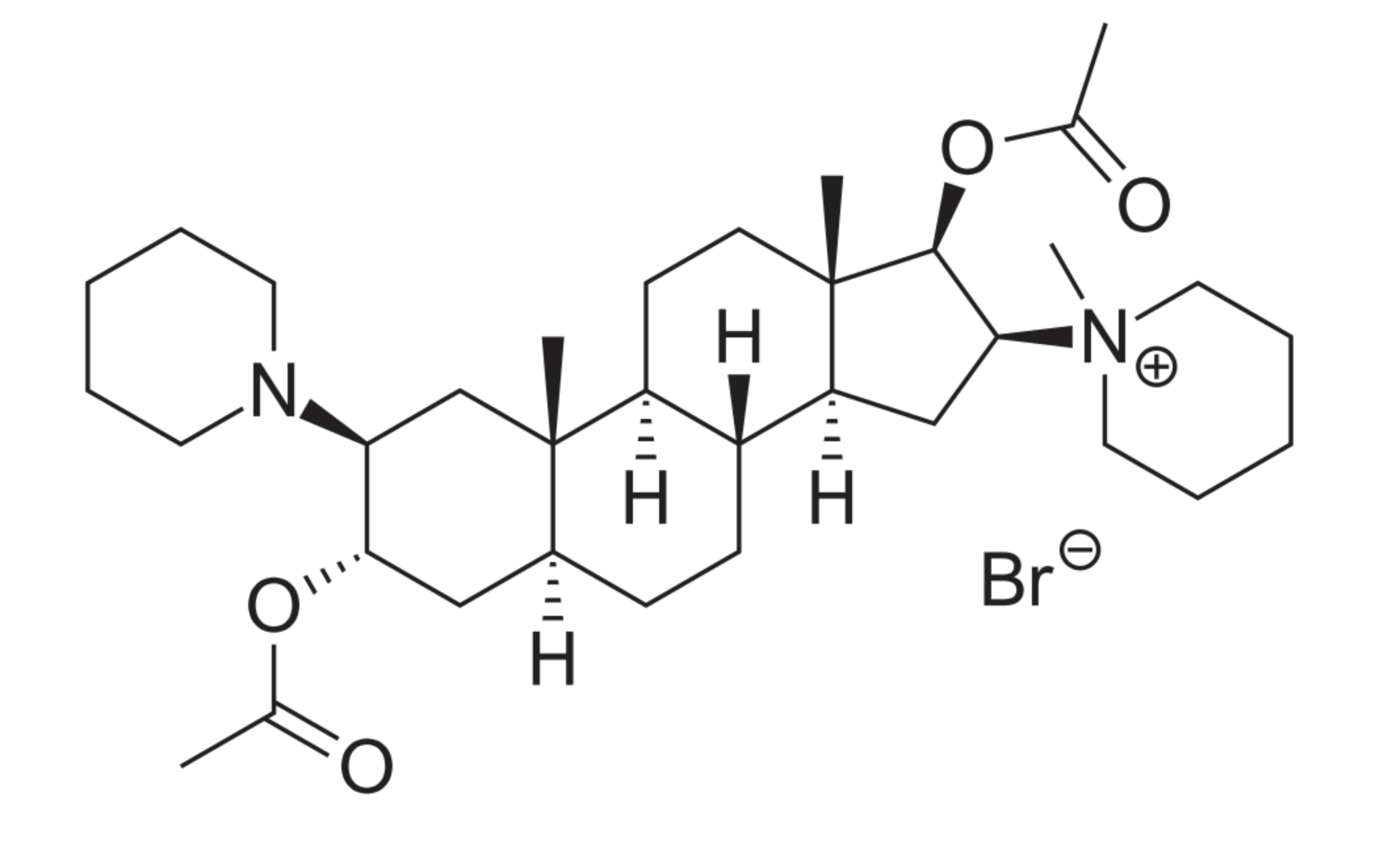

A public domain vecuronium bromide molecule, exciting!
Vecuronium Pharmacodynamics & Side Effects
| Mechanism of Action | Competitive non-depolarising neuromuscular blockade (Check out rocuronium for more details) |
| Chief Effect / Actions | Antagonism of acetylcholine at the nicotinic (N2) or (NAChRs) receptor situated on the post synaptic membrane of the skeletal neuromuscular junction. And antagonism on the pre-junctional modulatory -NAChR Vecuronium is 80x as potent at the NMJ compared with Vagal modulating ACHr receptors (N1 = ganglionic/vagal nicotinic/acetylcholine receptors) |
| Dose | ED90 is 0.057mg/kg dose. (57 micrograms per kilo) Dose: 0.08-0.1mg/kg — @75kg = 6mg – 7.5mg ONSET: 90-120 second wait to intubate Maximal blockade at 3-5 mins OFFSET: Lasts for 25-40 mins (95% twitch recovery at 45mins) Repeat maintenance doses 0.02 – 0.03mg/kg @75kg = 1.5 – 2.25mg Infuse at: 0.8-1.4mcg/kg/min Note, doubling the dose doesn’t achieve much more speed of onset… vecuronium is around 3-4x the potency atracurium. |
| Cardio-Vascular Side Effects | Headline : Large doses can increase CO and drop SVR (compensatory) Pancuronium, antagonised the lovely vagolytic effects of ‘3 tonnes’ of fentanyl in cardiac anaesthesia – vecuronium does not. |
| Respiratory Side Effects | Rate – Obliterated Depth – Obliterated Parenchymal effects: negligible to non existent histamine release |
| Central Nervous System Side Effects | Nil |
| Metabolic/MSK: Side Effects | Vecuronium may reduce the PT / PTT clotting times. |
| Caution | Anaphylaxis, rare reports. Prolonged effects (nile in other NMBs) in hypokalaemia, hypocalcaemia, hypermagnaesemia, and low protein states. |
| Notes | [Sugammadex](/episode/sugammadex/) will encapsulate vecuronium, and reverse its effects. |
Vecuronium Pharmacokinetics
| Absorption | n/a |
| Distribution | Volume of distribution 0.18-0.27 60-90% protein bound very small amounts may cross the placenta (negligible relevance) 9:1 (mum:baby) |
| Metabolism Remember: Phase I : [oxidation, reduction, hydrolysis] (more cytochrome action here) (more O2 needed) occurs in inner aspect of liver acinus… Phase II: [conjugation, glucoronidation, acetylation, sulphylation] (less O2 needed) occurs in outer aspect of liver acinus… | LIVER – Deacetylation into active metabolites. 3, and 17 hydroxyvecuronium and 3,17-dihydroxyvecuronium one off doses not a concern re metabolites, but in prolonged infusion in hepatic impaired you may see accumulation |
| Elimination | 25-30% unchanged in urine Metabolites come out in bile Clearance 3-6.4ml/kg/min Elimination 31-80 minutes HL |
Vecuronium in Anaesthesia
Clinical use of vecuronium requires understanding its reconstitution, neuromuscular monitoring, and reversal.
What is a lyophilized powder?
Lyophilized ‘freeze dry’
With the ice being removed by sublimation (transition from Solid > Gas state without being a liquid) in a near vacuum.
Preserves drugs, and creates a stable powder that will last, and can be reconstituted at leisure.
Agno Pharma, have a pretty good webpage describing it : https://agnopharma.com/blog/lyophilization-of-pharmaceuticals-an-overview/
Intro To Neuromuscular monitoring
Neuromuscular monitoring is a cornerstone of safe anaesthetic care when neuromuscular blocking agents are used.
There are subjective and objective methods to assessing someone for neuromuscular blockade.
Subjective can be subdivided into clinical signs and the visual interpretation of muscle contraction amplitude when using a testing device.
Objective involves a testing device that also has a means of measuring the resultant movement, or muscle signals associated with the stimulus by a nerve.
This stimulus must be supramaximal, to depolarise the motor nerve. This is generally >60mA (don’t forget that this is quite painful, attach the twitcher to yourself and turn it right down, and incrementally zap yourself, 20mA is spicy, it is not a competition…. but maybe it could be.)
Testing devices often provide three core tests.
TOF – Train of four, 4 maximal amplitude stimuli 0.5 seconds apart – | | | |
DBS – Double Burst stimulus, a pair of signals 750ms apart – | |
PTC – Post Tetanic Count – Constant electrical stimulus is delivered for five seconds, followed by a stimulus every second until you stop – }{}{}{}’ZAP‘{}{}{}{ |. |. |. |. |. |. |. |. |. |. |. |. |. |
PTC can be used to explore deep neuromuscular blockade, as the tetany liberates more acetylcholine into the NMJ, which will slowly fade into the abyss and you will see fade across your twitches
Train of Four
Commonly used, the consistent spacing and the length of time the test is over improves operator perception of fade.
Fade, the diminished amplitude of contraction over repeat contraction due to insufficient acetylcholine activity in the NMJ. ACh would normally stimulate pre-junctional nicotinic receptors at the motor nerve, near the terminal bouton. This stimulus encourages it to mobilise ACh vesicles towards the nerve ending ready to deploy if another contractile stimulus is received. Antagonised by Nicotinic AChRs! You will not see fade with suxamethonium, just diminished contractions with every zap of the same amplitude.
The goal post at which using neostigmine/glycopyrolate to reverse the residual effects of blockade has repeatedly moved over the decades, now you need to see four twitches, with fade before it being acceptable to reverse the patient, once upon it was fair game to only see three! (CHECK THIS!)
4 Twitches with fade = ~70%!! receptor occupancy
3 Twitches = 80%
No twitches = >90% of all nicotinic receptors blocked
Target TOF RATIO of >0.9 pre extubation is the goal. That is, the amplitude of the last twitch is >90% of the first twitch. You get there by waiting, sugammadex or neostigmine. But you dont want to be in a situation where the neostigmine wears off and ‘re-curarisation’ occurs as the rocuronium that was outcompeted by the increased concentration of acetylcholine start to turn the tide of battle (once more unto the breach! – Rocuronium V – Shakespeare) As such trying to get the neostigmine in a bit early, may need a double dose, but it is recommended to wait and use a bit less NMB agent next time.
Don’t Fire off a TOF see a little and then immediately fire off another TOF that will give you false reassurance, as you’ve juiced up that NMJ with acetylcholine, you need to give a reasonable gap of 10+ seconds.
Subjective clinical Signs
Signs of Recovery:
Sustained head raise from pillow
Sustained arm raise above head
Tidal volumes >500mls?
?Strong sustained hand grip?
Signs of Non-recovery:
Beyond obvious paralysis doctor…
Jerky, twitched movement that is unsustained, hoarse/non voice if extubated
Respiratory distress in recovery areas
Subjective approaches especially of the clinical sign variety have large interoperator variability, and lack sensitivity. especially when we consier that some muscle units recover faster from blockade than others (diaphragm fast, geniohyoid as a surrogate of airway tone, slower recovery.)
Objective methods
Need to be calibrated pre paralysis (so you anaesthetise, ensure deep enough that wont recall the pain of being zapped with a stimulus) and then paralyse.
Electromyography (EMG) Action potential of muscle detected
Acceleromyography (AMG) Accelerometer measure how much a thumb or toe swings
Kinesiomyography (KMG) – a bend sensor between thumb and hand
Mechanomyography (MMG) (mostly in research land)
Where to stick it?
You need a motor nerve near the body surface which operates a muscle that you can see the action of easily.
Common Choices
Ulnar nerve, will trigger thumb abduction, but also all hand interossei, and the lumbrical muscles of small and ring fingers.
Facial Nerve – you will probably catch temporal or zygomatic nerves, depending on where you put it. They recover from block earlier than diaphragm, and earlier than the ulnar nerve.
Posterior Tibial / Common peroneal (handy if the surgeons are fiddling with a head/chest and you cant get at the former sites.
Which way around do the stimulator electrodes go, and why?
The electrodes are placed with black (negative) distal this delivers energy more effectively!
‘red closest to the heart’
Why we are interested?
Beyond the obvious humanitarian goal of not having aware, partially paralysed, hypoxic patients, there is increased risk of post operative pulmonary complications when there is an absence of full reversal. In an elective setting in an otherwise well patient, developing a post operative pneumonia is a exceedingly sub-optimal post anaesthetic complication, that impairs recovery and may well lead to prolonged hospitalisation.
Once upon a time ‘recurarisation’ was an issue, as long acting drugs, were briefly competitively inhibited with a nice dose of neostigmine, only for them to rear there heads again as the ACH started to compete less again.
Another risk, is the unflushed cannula, with a ticked of something strong and paralysing. Remember we dose at multiples of the ED95, for convenience of onset, so a whiff left in a cannula or extension, may lead to quite a floppy patient! (same with remifentanil, and other strong drugs)
Summary
- Onset: 90–120 seconds; maximal blockade at 3–5 minutes (0.1 mg/kg).
- Duration: Intermediate-acting — 25–40 minutes at standard intubating doses.
- Cardiovascular profile: Minimal histamine release; does not antagonise vagolytic effects of high-dose opioids.
- Reversal: Fully reversible with sugammadex encapsulation; confirm TOF ratio >0.9 before extubation.
References
- The ‘New’ Relaxants is an excellent & informative paper – Torda TA. The ‘New’ Relaxants. A Review of the Clinical Pharmacology of Atracurium and Vecuronium. Anaesthesia and Intensive Care. 1987;15(1):72-82. doi:10.1177/0310057X8701500110
- Neuromuscular block management: evidence-based principles and practice Rodney, G. et al. BJA Education, Volume 24, Issue 1, 13 – 22
Thanks for listening. Take it day by day, don't overcook yourself — keep studying.
Transcript
29 min listenRead the full transcript
Enjoyed this? Review on Apple Podcasts Rate on Spotify
Support the show Help keep the lights on SBA question bank @ Teach Me Anaesthetics