
Vecuronium For Anaesthetists
26 February 2026
Introduction
Vecuronium is an intermediate-acting, aminosteroid, non-depolarising neuromuscular blocking agent used to facilitate endotracheal intubation and provide intraoperative relaxation. It is the mono-quaternary analogue of pancuronium, with minimal cardiovascular side effects and intermediate duration of action (25–40 minutes at standard intubating doses).
Vecuronium Pharmacology
Vecuronium, with a molecular weight of 637 g/mol, is supplied as a lyophilized powder requiring reconstitution. Its physico-chemical properties — including protein binding, aqueous instability, and aminosteroid structure — underpin its pharmacodynamic and pharmacokinetic profile.
Vecuronium Physico-Chemical properties
| Name | Vecuronium (Brand name Norcuron) |
| Class | A mono-quaternary aminosteroid |
| Chemical Make Up | The mono-quaternary analogue of pancuronium |
| History | Synthesised by Savage and Coaworks at the Organon research laboratories, in the same series of agents that yielded pancuronium. Vecuronium originally didnt seem to work very well and was minimally potent, poor storage possibly to blame as it is unstable in aqueous solution ( it undergoes hydrolysis ) |
| Isomer Status | Vecuronium is a single stereoisomer |
| Colour/Appearance | A lyophilized powder requiring reconstitution. Dilute in water – Stable for 24 hours Contains: Citrate/phosphate buffer Mannitol, (for tonicity) Sodium hydroxide of phosphoric acid (to achieve pH 4) Clear, colourless isotonic solution @ 2mg/ml Vecuronium Bromide Stable for 24 hours once made up at 25 °C |
| Molecular weight | Vecuronium 637 g/mol Note, Mivacurium 1029.3 g/mol, roc 529, suxamethonium 361, trac 929) |
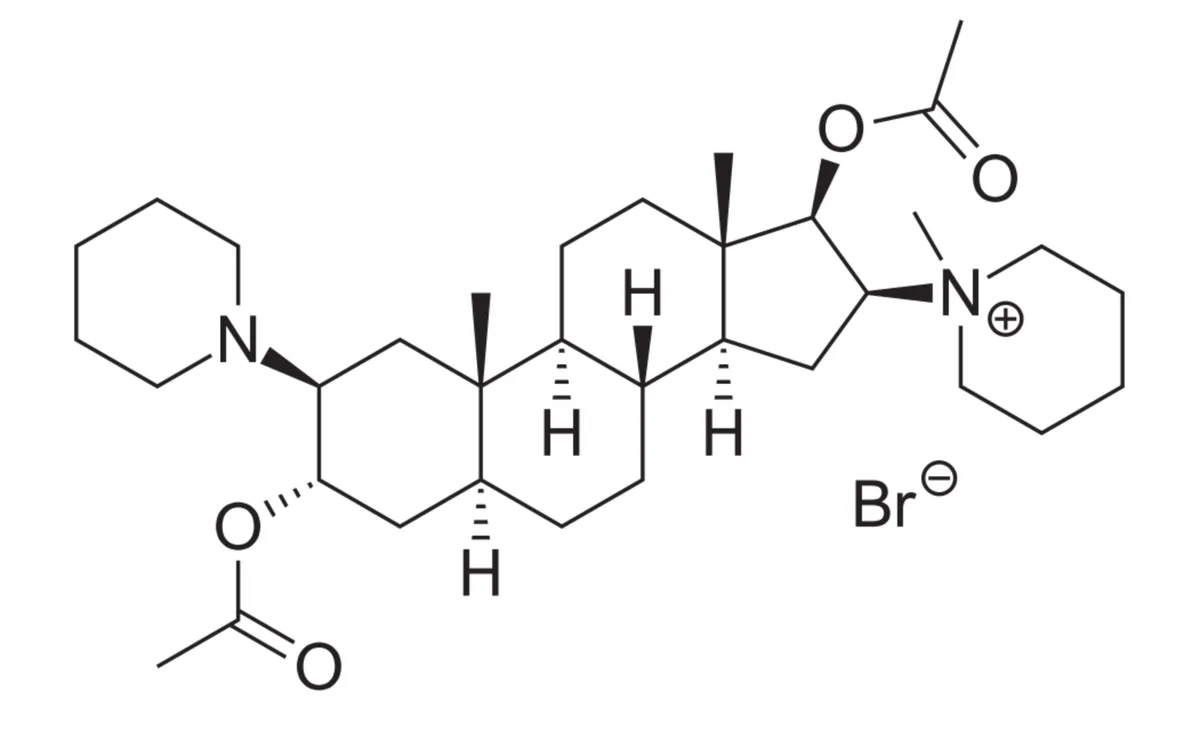
A public domain vecuronium bromide molecule, exciting!
Vecuronium Pharmacodynamics & Side Effects
| Mechanism of Action | Competitive non-depolarising neuromuscular blockade (Check out rocuronium for more details) |
| Chief Effect / Actions | Antagonism of acetylcholine at the nicotinic (N2) or (NAChRs) receptor situated on the post synaptic membrane of the skeletal neuromuscular junction. And antagonism on the pre-junctional modulatory -NAChR Vecuronium is 80x as potent at the NMJ compared with Vagal modulating ACHr receptors (N1 = ganglionic/vagal nicotinic/acetylcholine receptors) |
| Dose | ED90 is 0.057mg/kg dose. (57 micrograms per kilo) Dose: 0.08-0.1mg/kg — @75kg = 6mg – 7.5mg ONSET: 90-120 second wait to intubate Maximal blockade at 3-5 mins OFFSET: Lasts for 25-40 mins (95% twitch recovery at 45mins) Repeat maintenance doses 0.02 – 0.03mg/kg @75kg = 1.5 – 2.25mg Infuse at: 0.8-1.4mcg/kg/min Note, doubling the dose doesn’t achieve much more speed of onset… vecuronium is around 3-4x the potency atracurium. |
| Cardio-Vascular Side Effects | Headline : Large doses can increase CO and drop SVR (compensatory) Pancuronium, antagonised the lovely vagolytic effects of ‘3 tonnes’ of fentanyl in cardiac anaesthesia – vecuronium does not. |
| Respiratory Side Effects | Rate – Obliterated Depth – Obliterated Parenchymal effects: negligible to non existent histamine release |
| Central Nervous System Side Effects | Nil |
| Metabolic/MSK: Side Effects | Vecuronium may reduce the PT / PTT clotting times. |
| Caution | Anaphylaxis, rare reports. Prolonged effects (nile in other NMBs) in hypokalaemia, hypocalcaemia, hypermagnesaemia, and low protein states. |
| Notes | [Sugammadex](/episode/sugammadex/) will encapsulate vecuronium, and reverse its effects. |
Vecuronium Pharmacokinetics
| Absorption | n/a |
| Distribution | Volume of distribution 0.18-0.27 60-90% protein bound very small amounts may cross the placenta (negligible relevance) 9:1 (mum:baby) |
| Metabolism Remember: Phase I : [oxidation, reduction, hydrolysis] (more cytochrome action here) (more O2 needed) occurs in inner aspect of liver acinus… Phase II: [conjugation, glucoronidation, acetylation, sulphylation] (less O2 needed) occurs in outer aspect of liver acinus… | LIVER – Deacetylation into active metabolites. 3, and 17 hydroxyvecuronium and 3,17-dihydroxyvecuronium one off doses not a concern re metabolites, but in prolonged infusion in hepatic impaired you may see accumulation |
| Elimination | 25-30% unchanged in urine Metabolites come out in bile Clearance 3-6.4ml/kg/min Elimination 31-80 minutes HL |
Vecuronium in Anaesthesia
Clinical use of vecuronium requires understanding its reconstitution, neuromuscular monitoring, and reversal. Supplied as a lyophilized powder, the drug is monitored via Train of Four stimulation at the ulnar or facial nerve, and reversed with neostigmine once four twitches with fade are confirmed, or with sugammadex encapsulation.
What is a lyophilized powder?
Lyophilized ‘freeze dry’
With the ice being removed by sublimation (transition from Solid > Gas state without being a liquid) in a near vacuum.
Preserves drugs, and creates a stable powder that will last, and can be reconstituted at leisure.
Agno Pharma, have a pretty good webpage describing it : https://agnopharma.com/blog/lyophilization-of-pharmaceuticals-an-overview/
Intro To Neuromuscular monitoring
Neuromuscular monitoring is a cornerstone of safe anaesthetic care when neuromuscular blocking agents are used.
There are subjective and objective methods to assessing someone for neuromuscular blockade.
Subjective can be subdivided into clinical signs and the visual interpretation of muscle contraction amplitude when using a testing device.
Objective involves a testing device that also has a means of measuring the resultant movement, or muscle signals associated with the stimulus by a nerve.
This stimulus must be supramaximal, to depolarise the motor nerve. This is generally >60mA (don’t forget that this is quite painful, attach the twitcher to yourself and turn it right down, and incrementally zap yourself, 20mA is spicy, it is not a competition…. but maybe it could be.)
Testing devices often provide three core tests.
TOF – Train of four, 4 maximal amplitude stimuli 0.5 seconds apart – | | | |
DBS – Double Burst stimulus, a pair of signals 750ms apart – | |
PTC – Post Tetanic Count – Constant electrical stimulus is delivered for five seconds, followed by a stimulus every second until you stop – }{}{}{}’ZAP‘{}{}{}{ |. |. |. |. |. |. |. |. |. |. |. |. |. |
PTC can be used to explore deep neuromuscular blockade, as the tetany liberates more acetylcholine into the NMJ, which will slowly fade into the abyss and you will see fade across your twitches
Train of Four
Commonly used, the consistent spacing and the length of time the test is over improves operator perception of fade.
Fade, the diminished amplitude of contraction over repeat contraction due to insufficient acetylcholine activity in the NMJ. ACh would normally stimulate pre-junctional nicotinic receptors at the motor nerve, near the terminal bouton. This stimulus encourages it to mobilise ACh vesicles towards the nerve ending ready to deploy if another contractile stimulus is received. Antagonised by Nicotinic AChRs! You will not see fade with suxamethonium, just diminished contractions with every zap of the same amplitude.
The goal post at which using neostigmine/glycopyrolate to reverse the residual effects of blockade has repeatedly moved over the decades, now you need to see four twitches, with fade before it being acceptable to reverse the patient, once upon it was fair game to only see three!
4 Twitches with fade = ~70%!! receptor occupancy
3 Twitches = 80%
No twitches = >90% of all nicotinic receptors blocked
Target TOF RATIO of >0.9 pre extubation is the goal. That is, the amplitude of the last twitch is >90% of the first twitch. You get there by waiting, sugammadex or neostigmine. But you dont want to be in a situation where the neostigmine wears off and ‘re-curarisation’ occurs as the rocuronium that was outcompeted by the increased concentration of acetylcholine start to turn the tide of battle (once more unto the breach! – Rocuronium V – Shakespeare) As such trying to get the neostigmine in a bit early, may need a double dose, but it is recommended to wait and use a bit less NMB agent next time.
Don’t Fire off a TOF see a little and then immediately fire off another TOF that will give you false reassurance, as you’ve juiced up that NMJ with acetylcholine, you need to give a reasonable gap of 10+ seconds.
Subjective clinical Signs
Signs of Recovery:
Sustained head raise from pillow
Sustained arm raise above head
Tidal volumes >500mls?
?Strong sustained hand grip?
Signs of Non-recovery:
Beyond obvious paralysis doctor…
Jerky, twitched movement that is unsustained, hoarse/non voice if extubated
Respiratory distress in recovery areas
Subjective approaches especially of the clinical sign variety have large interoperator variability, and lack sensitivity. especially when we consier that some muscle units recover faster from blockade than others (diaphragm fast, geniohyoid as a surrogate of airway tone, slower recovery.)
Objective methods
Need to be calibrated pre paralysis (so you anaesthetise, ensure deep enough that wont recall the pain of being zapped with a stimulus) and then paralyse.
Electromyography (EMG) Action potential of muscle detected
Acceleromyography (AMG) Accelerometer measure how much a thumb or toe swings
Kinesiomyography (KMG) – a bend sensor between thumb and hand
Mechanomyography (MMG) (mostly in research land)
Where to stick it?
You need a motor nerve near the body surface which operates a muscle that you can see the action of easily.
Common Choices
Ulnar nerve, will trigger thumb abduction, but also all hand interossei, and the lumbrical muscles of small and ring fingers.
Facial Nerve – you will probably catch temporal or zygomatic nerves, depending on where you put it. They recover from block earlier than diaphragm, and earlier than the ulnar nerve.
Posterior Tibial / Common peroneal (handy if the surgeons are fiddling with a head/chest and you cant get at the former sites.
Which way around do the stimulator electrodes go, and why?
The electrodes are placed with black (negative) distal this delivers energy more effectively!
‘red closest to the heart’
Why we are interested?
Beyond the obvious humanitarian goal of not having aware, partially paralysed, hypoxic patients, there is increased risk of post operative pulmonary complications when there is an absence of full reversal. In an elective setting in an otherwise well patient, developing a post operative pneumonia is a exceedingly sub-optimal post anaesthetic complication, that impairs recovery and may well lead to prolonged hospitalisation.
Once upon a time ‘recurarisation’ was an issue, as long acting drugs, were briefly competitively inhibited with a nice dose of neostigmine, only for them to rear there heads again as the ACH started to compete less again.
Another risk, is the unflushed cannula, with a ticked of something strong and paralysing. Remember we dose at multiples of the ED95, for convenience of onset, so a whiff left in a cannula or extension, may lead to quite a floppy patient! (same with remifentanil, and other strong drugs)
Summary
- Onset: 90–120 seconds; maximal blockade at 3–5 minutes (0.1 mg/kg).
- Duration: Intermediate-acting — 25–40 minutes at standard intubating doses.
- Cardiovascular profile: Minimal histamine release; does not antagonise vagolytic effects of high-dose opioids.
- Reversal: Fully reversible with sugammadex encapsulation; confirm TOF ratio >0.9 before extubation.
References
- The ‘New’ Relaxants is an excellent & informative paper – Torda TA. The ‘New’ Relaxants. A Review of the Clinical Pharmacology of Atracurium and Vecuronium. Anaesthesia and Intensive Care. 1987;15(1):72-82. doi:10.1177/0310057X8701500110
- Neuromuscular block management: evidence-based principles and practice Rodney, G. et al. BJA Education, Volume 24, Issue 1, 13 – 22
Common questions
What is vecuronium and how does it work?
Vecuronium is a mono-quaternary aminosteroid non-depolarising neuromuscular blocking agent. It produces muscle relaxation by competitively antagonising acetylcholine at the nicotinic acetylcholine receptor (N2/NAChR) on the post-synaptic membrane of the skeletal neuromuscular junction. It is the mono-quaternary analogue of pancuronium, synthesised at the Organon research laboratories. It is 80 times more potent at the neuromuscular junction than at vagal nicotinic receptors, which accounts for its haemodynamic stability.
What is the clinical dose of vecuronium for intubation?
The ED90 of vecuronium is 0.057 mg/kg (57 micrograms per kilogram). The standard intubating dose is 0.08–0.1 mg/kg (approximately 6–7.5 mg for a 75 kg patient). Onset to intubating conditions is 90–120 seconds, with maximal blockade at 3–5 minutes. Duration of action is 25–40 minutes, with 95% twitch recovery at approximately 45 minutes. Maintenance doses are 0.02–0.03 mg/kg, or an infusion of 0.8–1.4 micrograms/kg/minute.
How is vecuronium metabolised and eliminated?
Vecuronium undergoes hepatic deacetylation to three active metabolites: 3-hydroxyvecuronium, 17-hydroxyvecuronium, and 3,17-dihydroxyvecuronium. It has a volume of distribution of 0.18–0.27 L/kg and is 60–90% protein bound. Approximately 25–30% is excreted unchanged in the urine, with metabolites excreted in bile. Clearance is 3–6.4 mL/kg/min and the elimination half-life is 31–80 minutes. In hepatic impairment, prolonged infusion may lead to accumulation of active metabolites.
What is Train of Four (TOF) and why is it important with vecuronium?
Train of Four (TOF) monitoring involves delivering four supramaximal electrical stimuli 0.5 seconds apart to a peripheral motor nerve (commonly the ulnar nerve) and assessing the resultant muscle contractions. The target TOF ratio prior to extubation is greater than 0.9 (the fourth twitch amplitude ≥90% of the first). Four twitches with fade correlates with approximately 70% receptor occupancy; three twitches indicates approximately 80% occupancy. Residual neuromuscular blockade (TOF ratio <0.9) is associated with an increased incidence of postoperative pulmonary complications. Objective measurement (acceleromyography or electromyography) is more reliable than subjective visual or tactile assessment.
How is vecuronium reversed?
Vecuronium-induced neuromuscular blockade can be reversed pharmacologically in two ways. Sugammadex encapsulates the vecuronium molecule directly, rapidly reversing blockade at any depth. Neostigmine (an acetylcholinesterase inhibitor) increases synaptic acetylcholine concentrations to outcompete the vecuronium at the nicotinic receptor; it should be used once at least four TOF twitches with fade are present, with a target TOF ratio >0.9 before extubation. Re-curarisation is a recognised risk if neostigmine is administered too early during deep block.
What are the cardiovascular side effects of vecuronium?
Vecuronium has a very favourable cardiovascular profile. At large doses, it can produce a modest increase in cardiac output with a compensatory fall in systemic vascular resistance. Importantly, unlike pancuronium (its parent compound), vecuronium does not possess vagolytic properties and therefore does not counteract the bradycardia associated with high-dose opioid cardiac anaesthesia. Histamine release is negligible, and direct myocardial effects are minimal. Rare anaphylaxis has been reported.
Thanks for listening. Take it day by day, don't overcook yourself — keep studying.
Transcript
29 min listenRead the full transcript
Gas Gas Gas: Vecuronium and Neuromuscular Monitoring (FRCA Primary)
Episode 54
Introduction: Welcome to Gas Gas Gas
00:00 – 00:44
Please listen carefully.
Hello, Team Anaesthesia. Welcome to Gas Gas Gas. This is the best anaesthetic science podcast for the FRCA Primary exam. Our goal is to fill your brain with all this highly useful information.
Now, you might be in the gym right now, commuting or ironing your scrubs, and there’s no judgement here. Gas Gas Gas will prime your brain for the monsoon of knowledge you need to imbibe. But regardless, the revision is eventually going to end. For now, expect facts, concepts, model answers, and the odd tangent.
Remember to check out the website, that’s gasgasgas.uk. There are show notes there with all the detail, plus links to foundational reference papers and anything else useful I find for you guys.
Anyway, buckle up, get ready for your mind to be bent into a new shape, and let’s get on with the show.
Episode Scope, and Vecuronium at a Glance
00:45 – 01:23
Key points
- Brand name: Norcuron.
- Classified as a monoquaternary aminosteroid neuromuscular blocking agent.
- The monoquaternary analogue of pancuronium.
[…] based on its physicochemical properties, pharmacodynamics and pharmacokinetics, with a subsequent wander into the monitoring of neuromuscular blockade.
We shouldn’t be using drugs unless we know how they behave inside a person, so that we can appreciate their characteristics, behaviours and foibles in the context of our diverse patient population. So without further ado, we’ll get on with the show.
So getting into the bulk of it, we’re talking vecuronium today, as you well know. Brand name, Norcuron, which does again sound like a dodgy Decepticon Transformer, but there we have it. Vecuronium is classified as a monoquaternary aminosteroid neuromuscular blocking agent, and it is the monoquaternary analogue of pancuronium.
Origin and Development
01:24 – 02:23
Key points
- Synthesised by Savage and co-workers at the Organon Research Laboratories.
- Emerged from the same series of agents that yielded pancuronium.
- Initially dismissed as insufficiently potent, but the real problem was storage: vecuronium is unstable in aqueous solution and hydrolyses.
Where’s it from? Who found it? So it was synthesised by Savage and co-workers at the Organon Research Laboratories in the US [see changelog]. It was found in the same series of agents that yielded pancuronium. Remember, it’s like a stereoisomer of pancuronium [see changelog].
And whilst they knew it existed, they thought that it wasn’t really a very useful stereoisomer in that gaggle of molecules in pancuronium, because it didn’t seem to be very potent. Ultimately what transpired was they weren’t storing it very well. It is unstable in aqueous solution, so if you leave your vecuronium in a test tube and come back to it the following day, it’s not going to be as potent, as it undergoes hydrolysis.
Presentation, Formulation and Physicochemical Properties
02:24 – 03:23
Key points
- Lyophilised powder requiring reconstitution in water. Stable for 24 hours once made up, at up to about 25 °C.
- The ampoule also contains a citrate phosphate buffer, mannitol for tonicity, and sodium hydroxide or phosphoric acid to achieve a pH of around 4.
- Once reconstituted: clear, colourless, isotonic, classically 2 mg/mL.
- Molecular weight 637. Heavier than rocuronium, but the benzylisoquinoliniums are larger still.
So, colour and appearance. It is a lyophilised powder requiring reconstitution in water. When you do so, it is stable for 24 hours, and that’s because it’s not just in water. There are a few other things in that ampoule. There’s a citrate phosphate buffer. There’s some mannitol to achieve a sensible tonicity, so it matches your plasma. And there is either sodium hydroxide or phosphoric acid to achieve a pH of around 4.
It will, once made up, be a clear, colourless, isotonic solution, classically mixed to 2 mg per mL. And it is stable for a day up to about 25 degrees C once made up.
Its molecular weight, 637. Remember that our benzylisoquinoliniums are quite big molecules, ish around twice the size or a third bigger, and vecuronium is a heavier molecule than rocuronium.
Now, if anyone wants to look at a lovely diagram of a molecule, check out the show notes. There is a public domain image of vecuronium, looking frankly complicated and well beyond me.
Mechanism of Action, and the N1 / N2 Distinction
03:24 – 04:53
Key points
- Non-depolarising agents act by competitive antagonism of acetylcholine at the neuromuscular junction.
- They act on post-junctional receptors (the muscle) and pre-junctional receptors, where modulation of nerve ending function occurs. This is the origin of fade.
- N2 is the neuromuscular junction nicotinic receptor. N1 is the ganglionic or vagal nicotinic receptor.
- Vecuronium is 80 times more potent at the neuromuscular junction than at vagal receptors. Older agents were far less discriminating.
So, mechanisms of action, pharmacodynamics, side effects of vecuronium. If you’re talking about these drugs, you need to be able to tell the examiner how it works, the doses you use, and the side effect profile.
And we’re going to introduce an additional concept here. Now, we’re going back in time and we’re thinking about slightly older drugs. We know that vecuronium, rocuronium and all its other neuromuscular blocking pals act on the nicotinic acetylcholine receptor. And you might have seen the abbreviation N2 knocking around. This N2, as you might be able to surmise, means that there’s probably an N1 nicotinic acetylcholine receptor somewhere. And you would be right.
The N1 is sometimes described as a ganglionic nicotinic receptor, or vagal nicotinic receptors. And these are receptors for acetylcholine. Remember, it’s called nicotinic just because nicotine binds to it, not because it’s some other clever thing going on, and they knew what nicotine was before they knew what acetylcholine was. I don’t think if you smoke too much you get floppy, though, but who knows? That’ll be an interesting question, but that’s for another time.
But ultimately, more modern drugs do not go forth and tickle N1 receptors. But once upon a time they were less specific, and they did indeed tickle N1 receptors. Just to highlight here, vecuronium is 80 times more potent at the neuromuscular junction’s receptors than its capacity to modulate your parasympathetic vagal nerve side of things. Really old-fashioned drugs were a little bit less discriminant than that. And this is down to the nature of the molecule.
But you should certainly be able to reel off in the exam that non-depolarising neuromuscular blocking agents act by competitive antagonism [see changelog] of acetylcholine at the neuromuscular junction, acting on post-junctional receptors, the muscle, but also pre-junctional receptors, where modulation of the function of that nerve ending occurs. This is where fade comes from.
Dosing, Onset and Offset, and Bowman’s Principle
04:54 – 06:53
Key points
- Vecuronium is three to four times as potent as atracurium.
- Intubating dose: 0.1 mg/kg. ED95 approximately 50 mcg/kg.
- Onset 90 to 120 seconds. Maximal blockade at 3 to 5 minutes. Offset 25 to 40 minutes. 95% twitch recovery at 45 minutes.
- Top-up dose: roughly a quarter of the intubating dose. Can also be infused.
- Bowman’s principle: potency is inversely proportional to onset time, because you cannot give as much of a potent drug. This is why rocuronium suits RSI.
Dosing of vecuronium. So vecuronium is three to four times as potent as atracurium. And as you can remember, we give about half a milligram per kilo-ish as a standard intubating dose, because otherwise you’d be waiting quite some time. And the standard intubating dose of vecuronium is 0.1 milligrams per kilo. The ED95 is about 50 micrograms per kilo. It just takes a while to work, so if you gave someone 50 mics per kilo, eventually they would be intubatable.
Onset time is 90 to 120 seconds, which is somewhat similar to atracurium, isn’t it? [see changelog] You will achieve maximal blockade at 3 to 5 minutes, and offset is 25 to 40 minutes, and you would see 95% recovery of those twitches at 45 minutes.
Generally, if you’ve intubated someone with vecuronium and then the surgeon’s saying, oh, they’re too tight, you might be tempted to give some more, and it would be recommended to give about a quarter of the dose you used to intubate them. So if you’re intubating a 75 kilo person, you might use 6 to 7.5 milligrams, so you might give them 1.5 to keep them paralysed. You can also infuse it, as you might expect.
So remember, vecuronium is more potent. We’re giving 6 mg to intubate someone. With rocuronium you might end up giving 40 mg. So now you know that I’m going to tell you yet again about Bowman’s principle, whereby the potency of a drug is inversely proportional to its onset time, because you just can’t give as much of it. This is why we use rocuronium for our RSIs, because we can use a big whacking dose to achieve a reasonable concentration gradient from plasma to your effect site, and therefore flood that neuromuscular junction with enough drug to achieve a rapid onset time.
Side Effects
06:54 – 08:23
Key points
- Cardiovascular: large doses can slightly raise cardiac output and drop systemic vascular resistance, probably compensatory.
- Respiratory: no meaningful histamine release. It does, of course, stop them breathing.
- May reduce prothrombin time.
- Reversible with sugammadex, which also works on vecuronium as well as rocuronium.
- Effect potentiated by the patient’s physiological state, electrolytes and temperature.
So, continuing with pharmacodynamics, what the drug does to the body. You would want to have an organised approach to discussing side effects, and that would classically go down the route of cardiac, respiratory, central nervous system and other. But it naturally varies with how much mischief the drug causes.
I hope you’re coming to the conclusion that paralysing drugs other than suxamethonium are actually generally quite stable. The headlines to remember, really: does it mess around with histamine, and its potential for anaphylaxis? That’s a nasty side effect.
So, vecuronium. Large doses can slightly nudge up your cardiac output and drop your systemic vascular resistance, and these are probably a compensatory thing going on here.
Respiratory side effects: it doesn’t really do anything with histamine, but naturally they are not going to breathe. Don’t forget that, very important. I wouldn’t say that in the exam, though, because you’d look a bit daft to say, well, the paralysing drug is going to stop them breathing. But it depends on your rapport with the examiner.
And interestingly, vecuronium might reduce your prothrombin time. I don’t think it’s going to be a treatment for massive obstetric haemorrhage, though.
Interestingly, sugammadex, whilst everyone knows it works on rocuronium, it also works on vecuronium. And its effect will be potentiated by the physiological state of the patient, their electrolyte state, their temperature, et cetera, et cetera.
Pharmacokinetics
08:24 – 09:53
Key points
- Volume of distribution 0.18 to 0.27 L/kg. Like most neuromuscular blockers, it prefers watery compartments.
- 60 to 90% protein bound.
- Minimal placental transfer: roughly a 9 to 1 maternal to fetal ratio.
- Hepatic metabolism by deacetylation, with active metabolites. Accumulation is a risk with prolonged infusion in liver failure.
- A quarter to a third excreted unchanged in urine. Metabolites go out in the bile.
- Clearance 3 to 6.4 mL/kg/min. Half-life 30 to 80 minutes.
Vecuronium pharmacokinetics. Remember, kinetics is what the body does to the drug. Break it down into absorption, distribution, metabolism, elimination.
How is vecuronium absorbed? Well, you could probably drink it. It probably wouldn’t do much. But distribution-wise, because remember we’re giving it IV, it has a volume of distribution that is low, 0.18 to 0.27, in the grand scheme of things. Much like most other neuromuscular blocking drugs, they prefer watery places. It is 60 to 90% protein bound, and very small amounts can squeak across the placenta, in a 9 to 1 ratio of vecuronium measured in mum to vecuronium measured in baby.
Metabolism of vecuronium. As with most other neuromuscular blocking drugs, the liver does get involved, and there are active metabolites of vecuronium. It undergoes deacetylation. You don’t really need to worry about the metabolic byproducts of vecuronium. Now, if you’re infusing vecuronium over eons on intensive care in someone with liver failure, then you might see some accumulation. Who knows if sugammadex works on those active metabolites?
Elimination. A quarter to a third comes out unchanged in the urine, so the liver just doesn’t really get around to it. Those metabolites often come out in the bile. Clearance is 3 to 6.4 mils per kilo per minute, and your half-life is 30 to 80 minutes.
Pretty brutal in an exam if someone is asking you what the clearance of vecuronium is. That’s more for your appreciation and knowledge and reference, if you want to compare clearances of drugs across the spectrum. They’re more interested in you knowing the onset and offset times and how to use the drug, as opposed to quoting all the minutiae. So don’t, you know, stress about that. Nice to know, not need to know.
Lyophilisation
09:54 – 11:22
Key points
- To lyophilise is to freeze dry. The drug is frozen, then ice is removed by sublimation in a near vacuum.
- Sublimation: solid straight to gas, skipping the liquid phase.
- Produces a stable powder for reconstitution at the point of use.
- Other lyophilised agents: thiopentone, remifentanil, vecuronium, and several antibiotics.
- Practical value: no cold chain, so it suits hot or austere environments.
But I’m sure that they could ask you, what is a lyophilised powder? Because remember, thiopentone is one, remifentanil is one, and vecuronium is one, as well as quite a few of the antibiotics we use.
So, to be lyophilised, or lyophilised, is to freeze dry. So you have your molecule floating around in aqueous solution. We know that the water’s not good for it, so we want to get it out. So you freeze it and then dry it, and the ice is removed by sublimation. Sublimation meaning to transition from solid to gas without being a liquid. This is achieved in a near vacuum. So if you drop the pressure, that water that’s a bit frozen is quite cold, actually wouldn’t mind being a gas. This is great for preserving drugs. It creates a stable powder that lasts, and you can reconstitute it at your convenience.
Now, there’s a link in the show notes to AGNO Pharma, and they’ve got a really good webpage that describes it, and, you know, they would offer to lyophilise your drugs if you so chose, I’m sure at great expense, but they describe the process quite well.
Are lyophilised drugs useful? Well, yeah. If you’re in a really hot place and you’re doing an anaesthetic in some compound in the Sahara Desert, do you want a drug that needs to be in a fridge? Absolutely not. You want a drug that you can leave in your rucksack and it work. You can imagine that your drug cupboard needs to be one that can tolerate heat in that environment, and might work without too much electricity being an issue and your cold chain not being an issue.
Sponsor: Teach Me Anaesthetics
11:23 – 13:01
Anyhow, time for a brief mention about the sponsors of Gas Gas Gas: Teach Me Anaesthetics. These guys are behind an excellent single best answer question resource. Firstly, I took the joyful, challenging and intermittent bashing through their 1100-plus questions, which they have written for the FRCA Primary exam. Now, I secretly loved it, and there are plenty of questions to test your knowledge.
When I was studying for the FRCA Primary it did not exist, but there were other packages online. These cost a lot more, and they didn’t really seem to reflect the content of the exams. Whilst doing them, I came across rehashed MRCP questions, which was not terribly inspiring and left me pretty cheesed off.
Whereas these single best answer questions have been built from the ground up. They have not sniffed an MCQ in a past life. They are based on the anaesthetic science you need to know, and there are explainers with all the questions, so it builds your knowledge as you work through them.
There is a multitude of ways you can study these questions. You could choose to do a random battle with 1100-plus questions, or split them into subject area. You can go back and redo the ones you’ve gotten wrong. It’s very malleable.
So if you’ve been thinking about which question resource you might want to get your hands on for the exam, you shouldn’t really look any further than Teach Me Anaesthetics. If you reckon it’s for you, all the links to Teach Me Anaesthetics from Gas Gas Gas are affiliate links. So if you’re signing up through one of those, you’re helping to support Gas Gas Gas. So if you think you’re going to go for it, click a link with me. You know you want to. You’ll not only be supporting your 100% favourite tell-your-nan-over-Sunday-lunch podcast, which is of course Gas Gas Gas.
Neuromuscular Monitoring: Subjective versus Objective, and the Supramaximal Stimulus
13:02 – 14:22
Key points
- Subjective methods: clinical signs, and visual assessment of contraction amplitude when using a stimulator.
- Objective methods: a stimulator with an integral sensing mechanism that measures the resultant movement or action potential.
- The stimulus must be supramaximal, enough to depolarise the whole motor nerve. Generally greater than 60 mA, hence cranking the stimulator to 70, 80 or 90 mA.
- A submaximal stimulus only partially depolarises the nerve, making the response uninterpretable.
- It is a painful stimulus. Do not test it on yourself at maximum, and remember it hurts a half-awake patient.
Okay, we are talking neuromuscular monitoring now. So it is naturally a cornerstone of safe anaesthetic care when neuromuscular blocking agents are used.
Naturally there are subjective and objective methods to monitoring your neuromuscular blockade. The subjective methods can be subdivided into clinical signs and the vision of muscle contraction amplitude when using a testing device. Whereas objective methods of monitoring neuromuscular blockade involve a testing device that also has an integral sensing mechanism, i.e. it can measure the resultant movement or action potentials within the muscles associated with that nerve stimulus.
When we talk about this nerve stimulus, it must be supramaximal. Enough of a zap to depolarise the whole motor nerve. Otherwise you only partially depolarise it, and therefore struggle to interpret the level of muscle contraction that you can achieve. So you have to really give it a whack. And this is generally greater than 60 milliamps, hence why you just crank up your twitchy box to maximum. Normally that’s 70, 80 or even 90 milliamps.
Now, if you’re curious, you can attach a twitchy box to yourself, but certainly do not turn it up to max, because it’s actually very painful. We must realise that if you’re waking someone up and they’re half awake and maybe stirring, and you check their twitches, that’s a painful stimulus, quite a significant one. So you can attach it to yourself, turn it all the way down, and press one of those buttons, and you will twitch, and it’ll be quite funny. You can test it on medical students too, if they’re not completely terrified.
Stimulation Patterns: TOF, DBS and PTC
14:23 – 15:52
Key points
- TOF, train of four: four supramaximal stimuli half a second apart, i.e. at 2 Hz.
- DBS, double burst stimulus: a pair of signals 750 milliseconds apart.
- PTC, post-tetanic count: a five-second tetanic burst, then a stimulus every second. Used to assess very deep blockade.
- PTC works because the tetanic contraction liberates acetylcholine into the junction, increasing the odds of transmission.
Now, there are a bunch of buttons on that machine, and I remember when I first started, I just thought, oh, these acronyms, I don’t know, but we do the TOF one. And TOF, train of four, that is four maximal amplitude stimuli half a second apart, i.e. at two hertz. Remember, a hertz is an event every second. 1 Hz, one event per second. 2 Hz, two events per second. I’m going to talk about TOF in more detail in a moment.
There are a few other buttons. You have DBS. Now, this isn’t the Disclosure and Barring Service, but a double burst stimulus. This is a pair of signals 750 milliseconds apart. I’m sure you’re seeing a bit of a trend. You need a number of signals, a distinct time separation apart, in which to interpret naturally a change in these signals over time.
And then there’s PTC, and that is post-tetanic count. Yet another method for assessing depth of blockade, chiefly used for very deep blockade. How does this work? It gives a five-second burst of constant electrical stimulus, so you can try and muster whatever sort of contraction you can out of that nerve. It then provides a stimulus every second until you stop. This gives you the capacity to assess very deep neuromuscular blockade, because that tetanic contraction will liberate acetylcholine into the neuromuscular junction and increase your odds of achieving transmission to the muscle.
Why Fade Matters: Receptor Occupancy
15:53 – 17:51
Key points
- Four twitches with fade still means roughly 70% of nicotinic receptors are occupied.
- Three twitches: 80%. No twitches: greater than 90%.
- The neuromuscular junction has a large receptor and acetylcholine reserve, so blockade is well advanced before twitches disappear.
- A patient with four twitches and fade has only about a third of their contractile capacity: they tire, they are weak, they may aspirate.
- Practice has shifted from reversing at three twitches to reversing at four twitches with fade. Full reversal is a fourth twitch greater than 90% of the first.
The fancy nerve stimulator testing devices that are slowly creeping into NHS practice do train of fours, but also do post-tetanic counts, to monitor when patients are significantly paralysed. Post-tetanic count helps to remind us that if you just do a train of four and don’t see anything, and then do another train of four and see something, and think […] [see changelog]
Why are we interested in fade? Surely we just say, oh well, they’re either paralysed or they’re not paralysed. Well, we all know it’s a spectrum, and we also should have at least a grip of the fact that the neuromuscular junction is abundantly set up to communicate a nerve signal to muscle, in that we have an excess of receptors and generally an excess of acetylcholine, so we can reliably move.
So a patient who has four twitches when you do a train of four, but you see some fade, still has 70% in general of their nicotinic acetylcholine receptors occupied. Three twitches, 80%. And no twitches, greater than 90% of all those receptors are blocked.
So you’re thinking, ah, well, they’ve got four twitches, do we really need to reverse them? You know, side effects of neostigmine. The answer is, well, they’ve only got a third of the ability to achieve a muscle contraction. Are they going to tire quite easily? Is that a little bit marginal? Are they going to be weak? Are they going to aspirate? All bad news.
Once upon a time we would reverse at three twitches. Now we reverse at four twitches with fade. And ideally, once you have gotten to a point where that fourth twitch is greater than 90% of the first twitch, you would classify them as reversed.
Reversal Practice and the Cost of Residual Blockade
17:52 – 18:51
Key points
- Common practice: neostigmine and glycopyrrolate for everyone, with a cultural drift towards routine sugammadex “just in case”.
- Sugammadex does cause anaphylaxis, and routine use is wasteful.
- Poorly reversed patients in recovery are jittery and jerky, and at increased risk of postoperative pulmonary complications (PPCs), i.e. pneumonia. Bad news after elective surgery.
Most folks just give everyone neostigmine and glycopyrrolate, and the zeitgeist, the culture, is progressively now towards just everyone gets sugammadex with no thinking, just in case. I don’t think I’m the just-in-case variety of doctor. You might well be. Less thinking if you just routinely give it to everyone, and we will stop wasting sugammadex unnecessarily. It does cause anaphylaxis.
The institutional concern, as you might expect, is poorly reversed patients in recovery don’t have a good time. They are jittery, jerky, and they are at increased risk of postoperative complications like postoperative pulmonary complications, PPCs, i.e. they get pneumonia. That’s bad news following elective surgery.
Subjective Clinical Signs
18:52 – 19:50
Key points
- Signs of recovery: sustained head lift from the pillow, sustained arm raise above the head, tidal volumes greater than 500 mL, sustained strong hand grip.
- Signs of non-recovery: jerky twitchy movements, hoarse or absent voice, respiratory distress in recovery.
- Clinical signs are terribly unreliable.
- Muscle groups recover at different rates. The diaphragm recovers fast, so the patient looks like they are breathing. The geniohyoid, a surrogate for airway tone, recovers slowly, so they may still be unable to swallow.
So I mentioned subjective and objective methods. Subjective clinical signs, which as you can probably imagine are terribly unreliable. If they can consistently raise their head from the pillow, can they consistently keep their arm raised above their head? Are their tidal volumes greater than 500 mils? And can they sustain a strong hand grip? Those are all signs of recovery.
And signs of non-recovery is if you’ve got a paralysed patient, obviously. If they have jerky, twitchy movements, they’ve got a hoarse voice, or they’ve not got a voice. You find someone in respiratory distress in recovery. Either that’s because they’ve inadvertently got some remifentanil that was left in the drip, a multitude of other reasons, or they’re still paralysed.
It’s important to also note that some muscle units recover faster from blockade than other muscle units. The diaphragm is really quick, so they’ll look like they’re breathing. But the geniohyoid, these tiny little muscles in the neck, which can be considered a surrogate of airway tone, easy to measure geniohyoid, harder to get at the cricoarytenoids, isn’t it, demonstrates slower recovery. So someone could be breathing but actually still not be able to swallow properly.
Objective Methods: EMG, AMG, KMG and MMG
19:51 – 20:50
Key points
- Four methods. Most need calibrating before paralysis, at a depth of anaesthesia sufficient that the patient will not feel the twitches or laryngospasm.
- EMG, electromyography: measures the muscle action potential.
- AMG, acceleromyography: an accelerometer measures how much the thumb or limb swings.
- KMG, kinemyography: a bend sensor between thumb and hand, measuring adductor pollicis movement on ulnar nerve stimulation.
- MMG, mechanomyography: research lab only, too calibration-heavy to be clinically useful.
And then objective methods. There are four. Often they need to be calibrated pre-paralysis, so you get someone deep, deep enough that they can’t feel twitches and go into laryngospasm, obviously. Deliver those signals, measure the responses, and then paralyse the patient.
And there are a bunch of methods. Four. EMG, electromyography: you measure the action potential in the muscle. AMG, acceleromyography: an accelerometer measures how much a thumb or a limb or an appendage swings. KMG, kinemyography: there’s a bend sensor between the thumb and the hand. So as you stimulate the ulnar nerve, you achieve contraction of adductor pollicis, which makes the thumb move towards the palm, and you measure that movement. And then mechanomyography, MMG, generally occurs in a research lab, because you’ve got to really calibrate it. It’s not very useful clinically.
Electrode Sites and Polarity
20:51 – 21:50
Key points
- Facial nerve: convenient when the head is accessible. Sensitive to early recovery, but recovers before the diaphragm and ulnar nerve, so it is unreliable as an endpoint.
- Ulnar nerve: adductor pollicis plus the interossei of the hand.
- Posterior tibial (behind the medial malleolus) or common peroneal (around the fibular head) when you cannot reach the top end.
- Polarity matters. The black, negative electrode goes distal. The red electrode goes proximal, closer to the heart. Reversed electrodes give a poor contraction.
Where do people commonly stick the electrodes to test a nerve? The facial nerve is very convenient, because you can generally get at the head, unless it’s ENT, head and neck or neurosurgery type stuff. Put it over the facial nerve and you’ll either catch the temporal branch, or if you lower the mandible, and it’s quite easy to see those contractions because you can get close to the face. However, the facial nerve recovers from block earlier than the diaphragm and earlier than the ulnar nerve, so whilst it’s sensitive for the beginnings of recovery, it’s not useful to identify the endpoint of recovery.
The ulnar nerve triggers thumb adduction [see changelog], as we know, but also all the interossei of the hand. So if you stick it on your own, you’ll feel your fingers want to draw together and contract to become apart at the same time, ish.
And then there’s posterior tibial or common peroneal, and this is handy if you can’t get to the top end. You put these behind the medial malleolus or around the fibular head.
I’m sure you’ve sometimes seen, wow, that’s a great contraction, and other times, oh, that’s not a very good contraction. This could be because the patient’s at varying depths of paralysis, or it could be because you put the electrodes the wrong way round. So the black electrode, the dark electrode, is the negative one, and that should be distal. It delivers the energy. The red electrode should be closest to the heart, or more proximal. This will deliver energy more effectively to the nerve, and thus you’ll see a better contraction.
Why It Matters: Residual Blockade and Unflushed Cannulas
21:51 – 23:28
Key points
- Beyond avoiding awake, partially paralysed, hypoxic patients: incomplete reversal increases postoperative pulmonary complications, impairs recovery and prolongs hospitalisation.
- Historical problem with long-acting agents such as pancuronium: patients looked reversed, then went floppy again in recovery.
- An unflushed cannula containing a potent agent is a live hazard. Because dosing is a multiple of the ED95, even a residual smidge can paralyse a patient later.
- Flush the cannula and remove the extensions. It is on the sign-out for a reason.
So why do we care? Why are we interested? Beyond the obvious humanitarian goal of not having aware, partially paralysed, hypoxic patients, we know that there is increased risk of post-op pulmonary complications when there is an absence of full reversal. And therefore, certainly in an elective setting in an otherwise well patient, if they were to get a post-op pneumonia, that’s not great at all, quite suboptimal. It’s going to impair recovery and it might lead to prolonged hospitalisation.
We know that once upon a time this was an issue: long-acting drugs, pancuronium, et cetera. You’d antagonise them with some neostigmine, the patient would wake up, look great, you’d send them to recovery, and they’d get floppy again.
Another risk that can lead to a paralysed patient in recovery or on the ward, which would certainly be bad, is an unflushed cannula with an agent that is potent in small doses, perhaps vecuronium, because you can draw that up into quite any concentration you fancy. Potent paralytics in an unflushed cannula or line is bad news, because remember, we generally dose at multiples of the ED95, the dose to achieve an effect in 95% of people, for convenience of onset, classically. So a smidge of paralysing agent, given enough time to percolate around someone, will lead to a floppy patient.
This is why we should be flushing our cannulas and getting those extensions off, because otherwise you might wake up at two in the morning and have to call the ward and say, whatever you do, don’t use that cannula. Not something I’ve done, but something one of my consultants mentioned. Thankfully it’s in that sign-out now, isn’t it? Flush the cannula, and you go, yes.
Single Best Answer: Scavenging Systems
23:29 – 26:44
Key points
- Correct order of components, following gas flow from patient to environment: collecting, transfer, receiving, disposal.
- Collecting system: 30 mm diameter, plumbs into the APL valve. Deliberately 30 mm so it cannot be connected into the breathing circuit.
- Transfer system: corrugated plastic hose from collecting to receiving system.
- Receiving system: open or closed. Open is for active scavenging only. Closed can be active or passive. Contains positive and negative pressure relief valves.
- Disposal system: active (vacuum driven, high or low pressure) or passive (driven by the patient’s own exhalation).
It’s now time for one of these delightful single best answer questions from Teach Me Anaesthetics. Now, naturally, I do love to keep you guys on your toes, and sometimes I ask you questions particular to the content of the podcast. Today’s not that day. Today, we’re talking scavenging.
So, medical scavenging systems reduce environmental exposure to waste anaesthetic gases in theatre. What is the correct order of components in a scavenging system? These components are a receiving system, a transfer system, a collecting system, and a disposal system.
You can probably work this one out. Or maybe not, because actually the answer starts with collecting system, transfer system, receiving system, disposal system.
There are four key components to a scavenging system, listed in order of gas flow from patient to the environment, i.e. out the window. You have a collecting system, and this is 30 mm in diameter. That typically plumbs into the APL valve. It’s 30 mm so you can’t accidentally connect it into your circuit. Remember, circuits are 22 mm adapters [see changelog].
There’s a transfer system. This is corrugated plastic hose connecting the collecting system to the receiving system.
Now, this receiving system can either be open or closed. Open systems are used with active scavenging only, while closed systems can be used with either active or passive. Remember, active or passive is: is there suction, or are you just hoping that it’s going to float down a pipe and out the window. This receiving system contains positive and negative pressure release valves, because you don’t want to inadvertently deliver pressure to your circuit because there’s a high wind outside hooting down the pipe.
And then a disposal system, which eliminates these waste gases to the environment. That can be active, as we’ve said, vacuum driven, in high or low pressure systems, or passive, i.e. the exhalation of the patient empties gas out of your circuit into your collecting system, where it journeys along the transfer system into the receiving system, where it is subsequently disposed of.
How super exciting. Aren’t we all lucky to have to study this? There’s an excellent book for equipment in anaesthesia called Equipment in Anaesthesia and Critical Care: A Complete Guide for the FRCA, by Daniel Aston, Angus Rivers and Asela Dharmadasa, which covers most things you need to know for equipment. We will get there eventually, but Teach Me Anaesthetics will get you there now. Check it out.
Summary and Sign-off
26:45 – 28:12
Key points
- Vecuronium suits environments with cold chain problems, because it is lyophilised.
- Reliably reversible with sugammadex.
- Notably more potent than rocuronium.
- Derived from the same series as pancuronium.
- Knowing onset and offset times is half the battle. The other half is monitoring, since clearance of vecuronium and rocuronium is not independent of liver function.
In summary, vecuronium is useful in environments where there are issues with cold chain management. It is reliably reversible with sugammadex. It is notably more potent than rocuronium. And remember that it is one of the isomers found in pancuronium [see changelog].
Having robust knowledge of onset and offset time of neuromuscular blocking agents is half the battle. The other half is appropriate and effective monitoring of the activity of these neuromuscular blocking agents in your particular patient, noting that everyone’s different, and the clearance of vecuronium and rocuronium is not independent of liver function.
You can either observe with clinical signs, observe subjectively with train-of-four monitoring, or with proprietary modern neuromuscular blockade monitoring devices like electromyography, mechanomyography and kinemyography that we spoke about earlier.
Anywho, I hope you certainly enjoyed that episode. I apologise if you hear the odd squeak of a child. I’ll try and remove him in post-production as best as I can. Have a lovely week. Cheerio and goodbye.
Outro
28:13 – 29:10
Ahoy, Team Anaesthesia! You’ve survived yet another episode of Gas Gas Gas. Now, if you found it useful, or harrowingly awful, please like and subscribe, drop us a star or twelve, and follow with whichever podcast platform you find yourself using. Please leave a comment or ping off an email if you think I need to square something away.
Now, there are a bunch of ways to support the costs of Gas Gas Gas, from buying me a coffee, to venturing forth via an affiliate link, to the hoard of joyful SBA questions from Teach Me Anaesthetics. Those links are on the website and in the show notes.
Speaking of the website, definitely check out gasgasgas.uk for the show notes, diagrams, details and the references.
Now, we all know, guys, that this is a bucket of content to consume, and it is like drinking from a fire hose. So I want to finish by saying: take it day by day, don’t overcook yourself, don’t freak out, and keep studying.
Enjoyed this? Review on Apple Podcasts Rate on Spotify
Support the show Help keep the lights on SBA question bank @ Teach Me Anaesthetics